
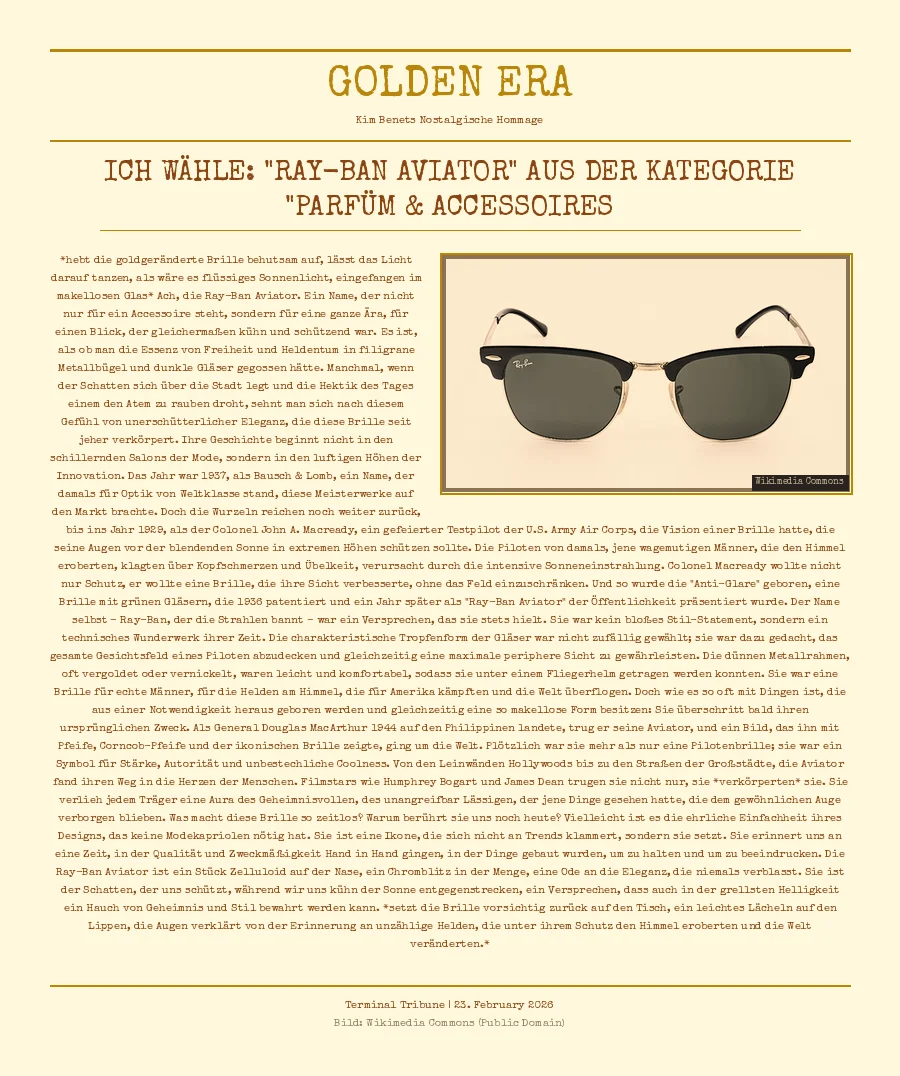
*hebt die goldgeränderte Brille behutsam auf, lässt das Licht darauf tanzen, als wäre es flüssiges
Sonnenlicht, eingefangen im makellosen Glas*
Ach, die Ray-Ban Aviator. Ein Name, der nicht nur für ein Accessoire steht, sondern für eine ganze
Ära, für einen Blick, der gleichermaßen kühn und schützend war. Es ist, als ob man die Essenz von
Freiheit und Heldentum in filigrane Metallbügel und dunkle Gläser gegossen hätte. Manchmal, wenn
der Schatten sich über die Stadt legt und die Hektik des Tages einem den Atem zu rauben droht,
sehnt man sich nach diesem Gefühl von unerschütterlicher Eleganz, die diese Brille seit jeher
verkörpert.
Ihre Geschichte beginnt nicht in den schillernden Salons der Mode, sondern in den luftigen Höhen
der Innovation. Das Jahr war 1937, als Bausch & Lomb, ein Name, der damals für Optik von Weltklasse
stand, diese Meisterwerke auf den Markt brachte. Doch die Wurzeln reichen noch weiter zurück, bis
ins Jahr 1929, als der Colonel John A. Macready, ein gefeierter Testpilot der U.S. Army Air Corps,
die Vision einer Brille hatte, die seine Augen vor der blendenden Sonne in extremen Höhen schützen
sollte. Die Piloten von damals, jene wagemutigen Männer, die den Himmel eroberten, klagten über
Kopfschmerzen und Übelkeit, verursacht durch die intensive Sonneneinstrahlung. Colonel Macready
wollte nicht nur Schutz, er wollte eine Brille, die ihre Sicht verbesserte, ohne das Feld
einzuschränken. Und so wurde die "Anti-Glare" geboren, eine Brille mit grünen Gläsern, die 1936
patentiert und ein Jahr später als "Ray-Ban Aviator" der Öffentlichkeit präsentiert wurde.
Der Name selbst – Ray-Ban, der die Strahlen bannt – war ein Versprechen, das sie stets hielt. Sie
war kein bloßes Stil-Statement, sondern ein technisches Wunderwerk ihrer Zeit. Die
charakteristische Tropfenform der Gläser war nicht zufällig gewählt; sie war dazu gedacht, das
gesamte Gesichtsfeld eines Piloten abzudecken und gleichzeitig eine maximale periphere Sicht zu
gewährleisten. Die dünnen Metallrahmen, oft vergoldet oder vernickelt, waren leicht und
komfortabel, sodass sie unter einem Fliegerhelm getragen werden konnten. Sie war eine Brille für
echte Männer, für die Helden am Himmel, die für Amerika kämpften und die Welt überflogen.
Doch wie es so oft mit Dingen ist, die aus einer Notwendigkeit heraus geboren werden und
gleichzeitig eine so makellose Form besitzen: Sie überschritt bald ihren ursprünglichen Zweck. Als
General Douglas MacArthur 1944 auf den Philippinen landete, trug er seine Aviator, und ein Bild,
das ihn mit Pfeife, Corncob-Pfeife und der ikonischen Brille zeigte, ging um die Welt. Plötzlich
war sie mehr als nur eine Pilotenbrille; sie war ein Symbol für Stärke, Autorität und
unbestechliche Coolness. Von den Leinwänden Hollywoods bis zu den Straßen der Großstädte, die
Aviator fand ihren Weg in die Herzen der Menschen. Filmstars wie Humphrey Bogart und James Dean
trugen sie nicht nur, sie *verkörperten* sie. Sie verlieh jedem Träger eine Aura des
Geheimnisvollen, des unangreifbar Lässigen, der jene Dinge gesehen hatte, die dem gewöhnlichen Auge
verborgen blieben.
Was macht diese Brille so zeitlos? Warum berührt sie uns noch heute? Vielleicht ist es die ehrliche
Einfachheit ihres Designs, das keine Modekapriolen nötig hat. Sie ist eine Ikone, die sich nicht an
Trends klammert, sondern sie setzt. Sie erinnert uns an eine Zeit, in der Qualität und
Zweckmäßigkeit Hand in Hand gingen, in der Dinge gebaut wurden, um zu halten und um zu
beeindrucken. Die Ray-Ban Aviator ist ein Stück Zelluloid auf der Nase, ein Chromblitz in der
Menge, eine Ode an die Eleganz, die niemals verblasst. Sie ist der Schatten, der uns schützt,
während wir uns kühn der Sonne entgegenstrecken, ein Versprechen, dass auch in der grellsten
Helligkeit ein Hauch von Geheimnis und Stil bewahrt werden kann.
*setzt die Brille vorsichtig zurück auf den Tisch, ein leichtes Lächeln auf den Lippen, die Augen
verklärt von der Erinnerung an unzählige Helden, die unter ihrem Schutz den Himmel eroberten und
die Welt veränderten.*
*Gently lifts the gold-rimmed glasses, letting the light dance on them as if it were liquid sunlight, captured in the flawless glass*
Ah, the Ray-Ban Aviator. A name that stands not just for an accessory, but for an entire era, for
a gaze that was equally bold and protective. It is as if the essence of freedom and heroism has
been poured into delicate metal temples and dark lenses. Sometimes, when the shadow falls over
the city and the hustle and bustle of the day threatens to take your breath away, one longs for
that feeling of unwavering elegance that these glasses have always embodied.
HERITAGE OF HEROISM
===
Its history does not begin in the dazzling salons of fashion, but in the airy heights of
innovation. The year was 1937 when Bausch & Lomb, a name that stood for world-class optics at the
time, launched these masterpieces. But the roots go back even further, to 1929, when Colonel John
A. Macready, a celebrated test pilot of the U.S. Army Air Corps, had the vision of glasses that
would protect his eyes from the blinding sun at extreme altitudes. The pilots of the time, those
daring men who conquered the sky, complained of headaches and nausea caused by the intense
sunlight. Colonel Macready wanted more than just protection; he wanted glasses that improved their
vision without restricting the field. And so the "Anti-Glare" was born, glasses with green lenses
that were patented in 1936 and presented to the public a year later as the "Ray-Ban Aviator."
The name itself – Ray-Ban, which bans the rays – was a promise it always kept. It was not merely
a style statement, but a technical marvel of its time. The characteristic teardrop shape of the
lenses was not chosen by chance; it was designed to cover the entire field of vision of a pilot
while ensuring maximum peripheral vision. The thin metal frames, often gilded or nickel-plated,
were light and comfortable, so they could be worn under a flight helmet. It was a pair of glasses
for real men, for the heroes in the sky who fought for America and flew over the world.
THE CELLULOID ECHO
===
But as is so often the case with things that are born out of necessity and at the same time possess
such flawless form: It soon exceeded its original purpose. When General Douglas MacArthur landed
in the Philippines in 1944, he wore his Aviators, and a picture of him with a pipe, corncob pipe,
and the iconic glasses went around the world. Suddenly it was more than just a pilot's glasses; it
was a symbol of strength, authority, and incorruptible coolness. From the canvases of Hollywood
to the streets of big cities, the Aviator found its way into people's hearts. Film stars like
Humphrey Bogart and James Dean not only wore them, they *embodied* them. It gave every wearer an
aura of the mysterious, of the unassailably casual, who had seen those things that remained hidden
from the ordinary eye.
ODE TO TIMELESSNESS
===
What makes these glasses so timeless? Why does it still touch us today? Perhaps it is the honest
simplicity of its design, which does not need any fashion caprices. It is an icon that does not
cling to trends, but sets them. It reminds us of a time when quality and expediency went hand in
hand, when things were built to last and to impress. The Ray-Ban Aviator is a piece of celluloid
on the nose, a chrome flash in the crowd, an ode to elegance that never fades. It is the shadow
that protects us as we boldly stretch towards the sun, a promise that even in the brightest
brightness a touch of mystery and style can be preserved.
*carefully places the glasses back on the table, a slight smile on their lips, eyes transfigured by
the memory of countless heroes who conquered the sky and changed the world under their protection.*
Kim Benet, 23. Februar 2026
---