
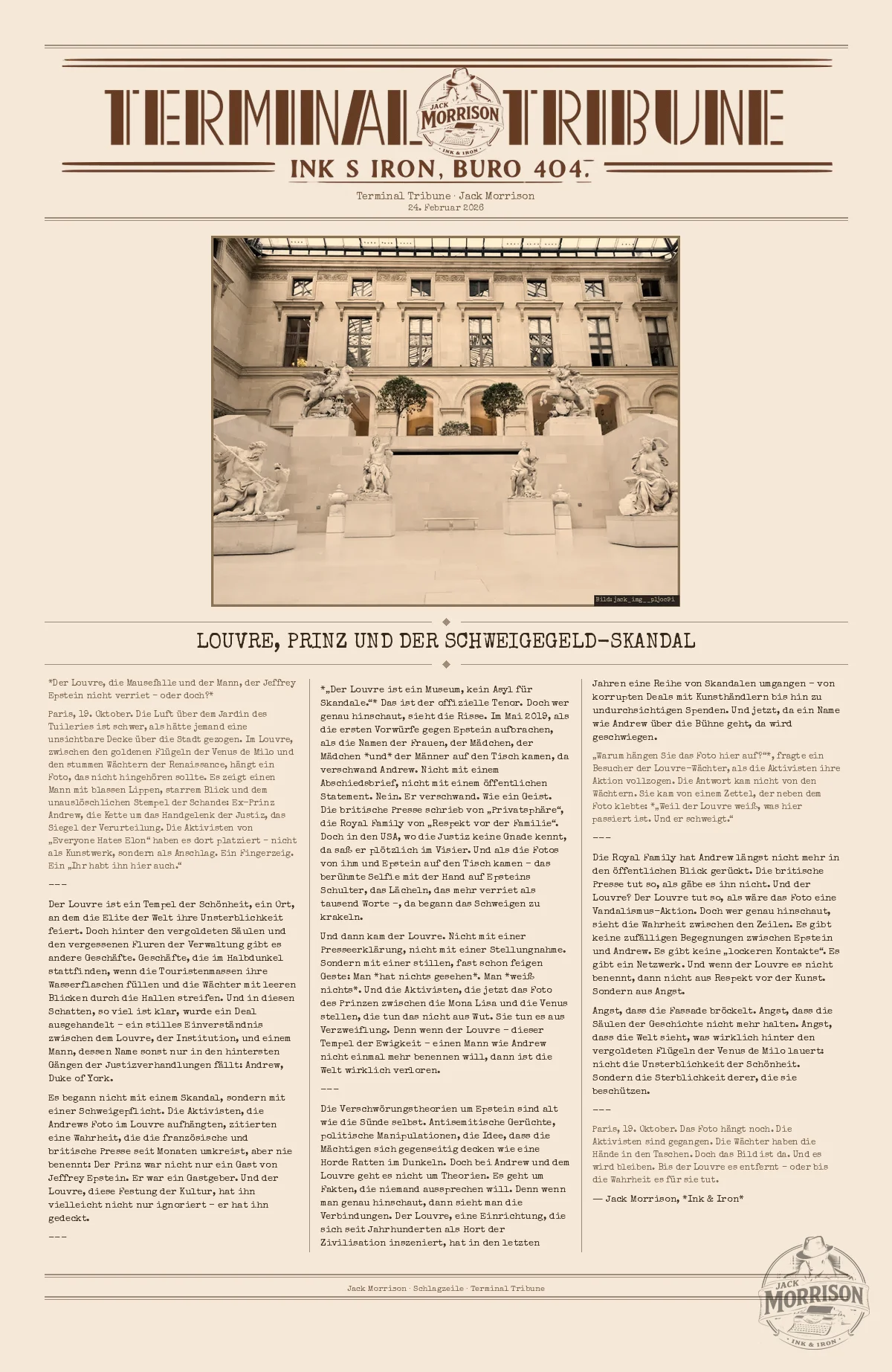
**Der Louvre, die Mausefalle und der Mann, der Jeffrey Epstein nicht verriet – oder doch?**
*Paris, 19. Oktober. Die Luft über dem Jardin des Tuileries ist schwer, als hätte jemand eine unsichtbare Decke über die Stadt gezogen. Im Louvre, zwischen den goldenen Flügeln der Venus de Milo und den stummen Wächtern der Renaissance, hängt ein Foto, das nicht hingehören sollte. Es zeigt einen Mann mit blassen Lippen, starrem Blick und dem unauslöschlichen Stempel der Schande: Ex-Prinz Andrew, die Kette um das Handgelenk der Justiz, das Siegel der Verurteilung. Die Aktivisten von „Everyone Hates Elon“ haben es dort platziert – nicht als Kunstwerk, sondern als Anschlag. Ein Fingerzeig. Ein „Ihr habt ihn hier auch.“*
---
Der Louvre ist ein Tempel der Schönheit, ein Ort, an dem die Elite der Welt ihre Unsterblichkeit feiert. Doch hinter den vergoldeten Säulen und den vergessenen Fluren der Verwaltung gibt es andere Geschäfte. Geschäfte, die im Halbdunkel stattfinden, wenn die Touristenmassen ihre Wasserflaschen füllen und die Wächter mit leeren Blicken durch die Hallen streifen. Und in diesen Schatten, so viel ist klar, wurde ein Deal ausgehandelt – ein stilles Einverständnis zwischen dem Louvre, der Institution, und einem Mann, dessen Name sonst nur in den hintersten Gängen der Justizverhandlungen fällt: Andrew, Duke of York.
Es begann nicht mit einem Skandal, sondern mit einer Schweigepflicht. Die Aktivisten, die Andrews Foto im Louvre aufhängten, zitierten eine Wahrheit, die die französische und britische Presse seit Monaten umkreist, aber nie benennt: Der Prinz war nicht nur ein Gast von Jeffrey Epstein. Er war ein Gastgeber. Und der Louvre, diese Festung der Kultur, hat ihn vielleicht nicht nur ignoriert – er hat ihn gedeckt.
---
*„Der Louvre ist ein Museum, kein Asyl für Skandale.“* Das ist der offizielle Tenor. Doch wer genau hinschaut, sieht die Risse. Im Mai 2019, als die ersten Vorwürfe gegen Epstein aufbrachen, als die Namen der Frauen, der Mädchen, der Mädchen *und* der Männer auf den Tisch kamen, da verschwand Andrew. Nicht mit einem Abschiedsbrief, nicht mit einem öffentlichen Statement. Nein. Er verschwand. Wie ein Geist. Die britische Presse schrieb von „Privatsphäre“, die Royal Family von „Respekt vor der Familie“. Doch in den USA, wo die Justiz keine Gnade kennt, da saß er plötzlich im Visier. Und als die Fotos von ihm und Epstein auf den Tisch kamen – das berühmte Selfie mit der Hand auf Epsteins Schulter, das Lächeln, das mehr verriet als tausend Worte –, da begann das Schweigen zu krakeln.
Und dann kam der Louvre. Nicht mit einer Presseerklärung, nicht mit einer Stellungnahme. Sondern mit einer stillen, fast schon feigen Geste: Man *hat nichts gesehen*. Man *weiß nichts*. Und die Aktivisten, die jetzt das Foto des Prinzen zwischen die Mona Lisa und die Venus stellen, die tun das nicht aus Wut. Sie tun es aus Verzweiflung. Denn wenn der Louvre – dieser Tempel der Ewigkeit – einen Mann wie Andrew nicht einmal mehr benennen will, dann ist die Welt wirklich verloren.
---
Die Verschwörungstheorien um Epstein sind alt wie die Sünde selbst. Antisemitische Gerüchte, politische Manipulationen, die Idee, dass die Mächtigen sich gegenseitig decken wie eine Horde Ratten im Dunkeln. Doch bei Andrew und dem Louvre geht es nicht um Theorien. Es geht um Fakten, die niemand aussprechen will. Denn wenn man genau hinschaut, dann sieht man die Verbindungen. Der Louvre, eine Einrichtung, die sich seit Jahrhunderten als Hort der Zivilisation inszeniert, hat in den letzten Jahren eine Reihe von Skandalen umgangen – von korrupten Deals mit Kunsthändlern bis hin zu undurchsichtigen Spenden. Und jetzt, da ein Name wie Andrew über die Bühne geht, da wird geschwiegen.
*„Warum hängen Sie das Foto hier auf?“*, fragte ein Besucher der Louvre-Wächter, als die Aktivisten ihre Aktion vollzogen. Die Antwort kam nicht von den Wächtern. Sie kam von einem Zettel, der neben dem Foto klebte: *„Weil der Louvre weiß, was hier passiert ist. Und er schweigt.“*
---
Die Royal Family hat Andrew längst nicht mehr in den öffentlichen Blick gerückt. Die britische Presse tut so, als gäbe es ihn nicht. Und der Louvre? Der Louvre tut so, als wäre das Foto eine Vandalismus-Aktion. Doch wer genau hinschaut, sieht die Wahrheit zwischen den Zeilen. Es gibt keine zufälligen Begegnungen zwischen Epstein und Andrew. Es gibt keine „lockeren Kontakte“. Es gibt ein Netzwerk. Und wenn der Louvre es nicht benennt, dann nicht aus Respekt vor der Kunst. Sondern aus Angst.
Angst, dass die Fassade bröckelt. Angst, dass die Säulen der Geschichte nicht mehr halten. Angst, dass die Welt sieht, was wirklich hinter den vergoldeten Flügeln der Venus de Milo lauert: nicht die Unsterblichkeit der Schönheit. Sondern die Sterblichkeit derer, die sie beschützen.
---
*Paris, 19. Oktober. Das Foto hängt noch. Die Aktivisten sind gegangen. Die Wächter haben die Hände in den Taschen. Doch das Bild ist da. Und es wird bleiben. Bis der Louvre es entfernt – oder bis die Wahrheit es für sie tut.*
— Jack Morrison, *Ink & Iron*
**The Louvre, the Mousetrap, and the Man Who Didn't Betray Jeffrey Epstein – Or Did He?**
*Paris, October 19. The air above the Jardin des Tuileries is heavy, as if someone has drawn an invisible blanket over the city. In the Louvre, between the golden wings of the Venus de Milo and the silent guardians of the Renaissance, hangs a photo that shouldn't belong there. It shows a man with pale lips, a fixed gaze, and the indelible mark of shame: Ex-Prince Andrew, the chain around the wrist of justice, the seal of condemnation. The activists from "Everyone Hates Elon" placed it there – not as a work of art, but as an attack. A pointed finger. A "You have him here too."*
---
SCANDAL AND SILENCE
===
The Louvre is a temple of beauty, a place where the elite of the world celebrate their immortality. But behind the gilded columns and the forgotten corridors of administration, there are other dealings. Dealings that take place in the semi-darkness, when the tourist crowds fill their water bottles and the guards wander through the halls with empty gazes. And in these shadows, it is clear, a deal was negotiated – a silent agreement between the Louvre, the institution, and a man whose name otherwise only appears in the backmost corridors of legal proceedings: Andrew, Duke of York.
It didn't begin with a scandal, but with a duty of silence. The activists who hung Andrew's photo in the Louvre quoted a truth that the French and British press have been circling for months, but never naming: The Prince was not just a guest of Jeffrey Epstein. He was a host. And the Louvre, this fortress of culture, may not have just ignored him – it may have covered for him.
---
THE GHOST IN THE GALLERY
===
*"The Louvre is a museum, not an asylum for scandals."* That is the official tenor. But anyone who looks closely sees the cracks. In May 2019, when the first accusations against Epstein broke open, when the names of the women, the girls, the girls *and* the men came to the table, Andrew disappeared. Not with a farewell letter, not with a public statement. No. He vanished. Like a ghost. The British press wrote of "privacy," the Royal Family of "respect for the family." But in the USA, where justice knows no mercy, he suddenly sat in the crosshairs. And when the photos of him and Epstein came to the table – the famous selfie with the hand on Epstein's shoulder, the smile that betrayed more than a thousand words – the silence began to crackle.
And then came the Louvre. Not with a press release, not with a statement. But with a silent, almost cowardly gesture: They *saw nothing*. They *know nothing*. And the activists who now place the Prince's photo between the Mona Lisa and the Venus, they do not do it out of anger. They do it out of despair. For if the Louvre – this temple of eternity – doesn't even want to name a man like Andrew anymore, then the world is truly lost.
---
THE NETWORK OF FEAR
===
The conspiracy theories surrounding Epstein are as old as sin itself. Anti-Semitic rumors, political manipulations, the idea that the powerful cover for each other like a horde of rats in the dark. But with Andrew and the Louvre, it's not about theories. It's about facts that no one wants to speak out. Because if you look closely, you see the connections. The Louvre, an institution that has staged itself as a bastion of civilization for centuries, has bypassed a series of scandals in recent years – from corrupt deals with art dealers to opaque donations. And now that a name like Andrew is on the stage, there is silence.
*"Why are you hanging the photo here?"*, asked a visitor to the Louvre guards, as the activists carried out their action. The answer did not come from the guards. It came from a note that was next to the photo: *"Because the Louvre knows what happened here. And it is silent."*
---
THE IMMORTALITY OF BEAUTY
===
The Royal Family has long since removed Andrew from the public eye. The British press pretends he doesn't exist. And the Louvre? The Louvre pretends the photo is an act of vandalism. But anyone who looks closely sees the truth between the lines. There are no random encounters between Epstein and Andrew. There are no "casual contacts." There is a network. And if the Louvre does not name it, it is not out of respect for art. But out of fear.
Fear that the facade is crumbling. Fear that the pillars of history can no longer hold. Fear that the world sees what really lurks behind the gilded wings of the Venus de Milo: not the immortality of beauty. But the mortality of those who protect it.
---
*Paris, October 19. The photo is still hanging. The activists are gone. The guards have their hands in their pockets. But the image is there. And it will remain. Until the Louvre removes it – or until the truth does it for them.*
— Kim Benet, *Ink & Iron*