
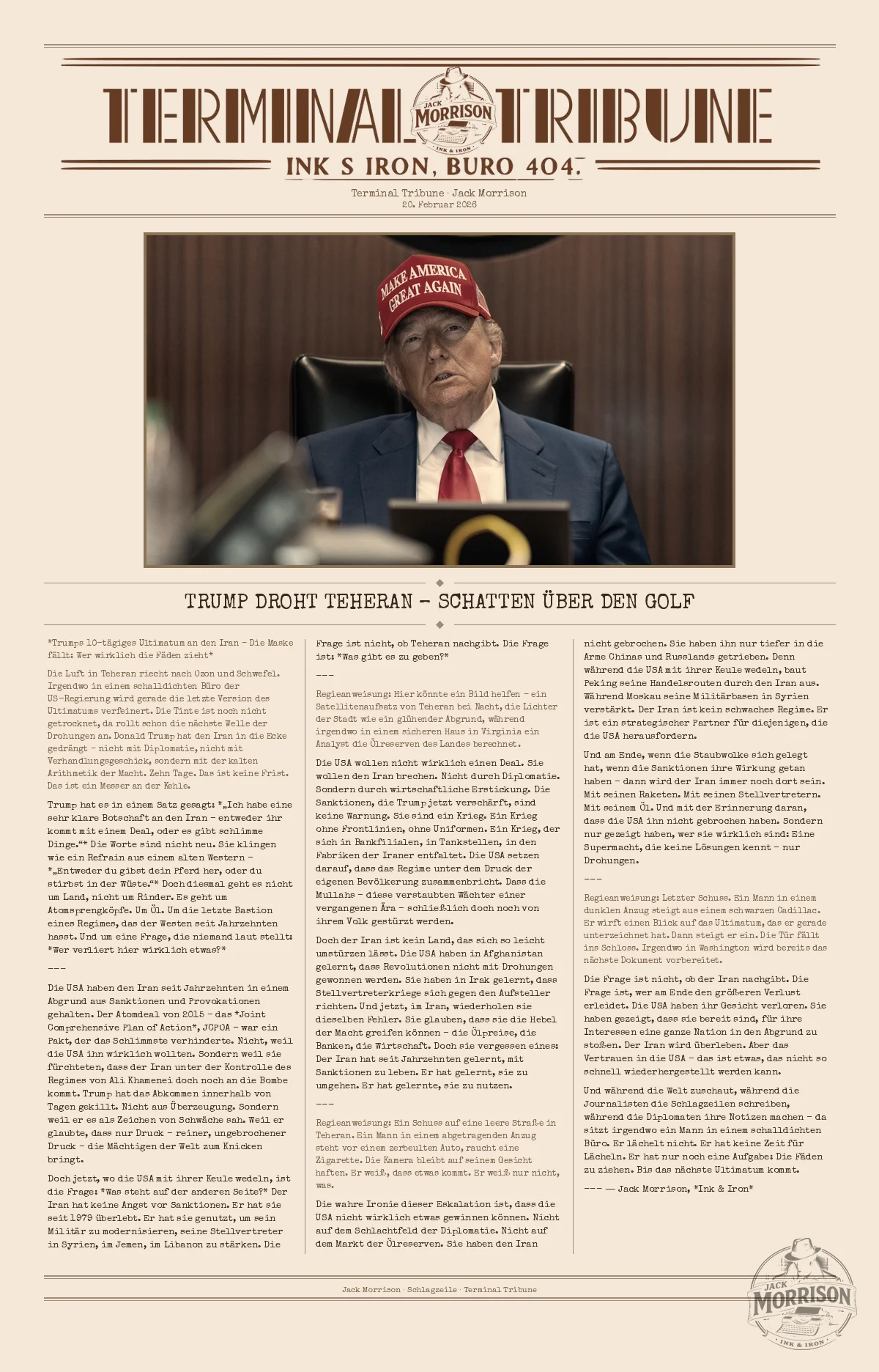
**Trumps 10-tägiges Ultimatum an den Iran – Die Maske fällt: Wer wirklich die Fäden zieht**
*Die Luft in Teheran riecht nach Ozon und Schwefel. Irgendwo in einem schalldichten Büro der US-Regierung wird gerade die letzte Version des Ultimatums verfeinert. Die Tinte ist noch nicht getrocknet, da rollt schon die nächste Welle der Drohungen an. Donald Trump hat den Iran in die Ecke gedrängt – nicht mit Diplomatie, nicht mit Verhandlungsgeschick, sondern mit der kalten Arithmetik der Macht. Zehn Tage. Das ist keine Frist. Das ist ein Messer an der Kehle.*
Trump hat es in einem Satz gesagt: *„Ich habe eine sehr klare Botschaft an den Iran – entweder ihr kommt mit einem Deal, oder es gibt schlimme Dinge.“* Die Worte sind nicht neu. Sie klingen wie ein Refrain aus einem alten Western – *„Entweder du gibst dein Pferd her, oder du stirbst in der Wüste.“* Doch diesmal geht es nicht um Land, nicht um Rinder. Es geht um Atomsprengköpfe. Um Öl. Um die letzte Bastion eines Regimes, das der Westen seit Jahrzehnten hasst. Und um eine Frage, die niemand laut stellt: *Wer verliert hier wirklich etwas?*
---
Die USA haben den Iran seit Jahrzehnten in einem Abgrund aus Sanktionen und Provokationen gehalten. Der Atomdeal von 2015 – das *Joint Comprehensive Plan of Action*, JCPOA – war ein Pakt, der das Schlimmste verhinderte. Nicht, weil die USA ihn wirklich wollten. Sondern weil sie fürchteten, dass der Iran unter der Kontrolle des Regimes von Ali Khamenei doch noch an die Bombe kommt. Trump hat das Abkommen innerhalb von Tagen gekillt. Nicht aus Überzeugung. Sondern weil er es als Zeichen von Schwäche sah. Weil er glaubte, dass nur Druck – reiner, ungebrochener Druck – die Mächtigen der Welt zum Knicken bringt.
Doch jetzt, wo die USA mit ihrer Keule wedeln, ist die Frage: *Was steht auf der anderen Seite?* Der Iran hat keine Angst vor Sanktionen. Er hat sie seit 1979 überlebt. Er hat sie genutzt, um sein Militär zu modernisieren, seine Stellvertreter in Syrien, im Jemen, im Libanon zu stärken. Die Frage ist nicht, ob Teheran nachgibt. Die Frage ist: *Was gibt es zu geben?*
---
*Regieanweisung: Hier könnte ein Bild helfen – ein Satellitenaufsatz von Teheran bei Nacht, die Lichter der Stadt wie ein glühender Abgrund, während irgendwo in einem sicheren Haus in Virginia ein Analyst die Ölreserven des Landes berechnet.*
Die USA wollen nicht wirklich einen Deal. Sie wollen den Iran brechen. Nicht durch Diplomatie. Sondern durch wirtschaftliche Erstickung. Die Sanktionen, die Trump jetzt verschärft, sind keine Warnung. Sie sind ein Krieg. Ein Krieg ohne Frontlinien, ohne Uniformen. Ein Krieg, der sich in Bankfilialen, in Tankstellen, in den Fabriken der Iraner entfaltet. Die USA setzen darauf, dass das Regime unter dem Druck der eigenen Bevölkerung zusammenbricht. Dass die Mullahs – diese verstaubten Wächter einer vergangenen Ära – schließlich doch noch von ihrem Volk gestürzt werden.
Doch der Iran ist kein Land, das sich so leicht umstürzen lässt. Die USA haben in Afghanistan gelernt, dass Revolutionen nicht mit Drohungen gewonnen werden. Sie haben in Irak gelernt, dass Stellvertreterkriege sich gegen den Aufsteller richten. Und jetzt, im Iran, wiederholen sie dieselben Fehler. Sie glauben, dass sie die Hebel der Macht greifen können – die Ölpreise, die Banken, die Wirtschaft. Doch sie vergessen eines: Der Iran hat seit Jahrzehnten gelernt, mit Sanktionen zu leben. Er hat gelernt, sie zu umgehen. Er hat gelernte, sie zu nutzen.
---
*Regieanweisung: Ein Schuss auf eine leere Straße in Teheran. Ein Mann in einem abgetragenden Anzug steht vor einem zerbeulten Auto, raucht eine Zigarette. Die Kamera bleibt auf seinem Gesicht haften. Er weiß, dass etwas kommt. Er weiß nur nicht, was.*
Die wahre Ironie dieser Eskalation ist, dass die USA nicht wirklich etwas gewinnen können. Nicht auf dem Schlachtfeld der Diplomatie. Nicht auf dem Markt der Ölreserven. Sie haben den Iran nicht gebrochen. Sie haben ihn nur tiefer in die Arme Chinas und Russlands getrieben. Denn während die USA mit ihrer Keule wedeln, baut Peking seine Handelsrouten durch den Iran aus. Während Moskau seine Militärbasen in Syrien verstärkt. Der Iran ist kein schwaches Regime. Er ist ein strategischer Partner für diejenigen, die die USA herausfordern.
Und am Ende, wenn die Staubwolke sich gelegt hat, wenn die Sanktionen ihre Wirkung getan haben – dann wird der Iran immer noch dort sein. Mit seinen Raketen. Mit seinen Stellvertretern. Mit seinem Öl. Und mit der Erinnerung daran, dass die USA ihn nicht gebrochen haben. Sondern nur gezeigt haben, wer sie wirklich sind: Eine Supermacht, die keine Lösungen kennt – nur Drohungen.
---
*Regieanweisung: Letzter Schuss. Ein Mann in einem dunklen Anzug steigt aus einem schwarzen Cadillac. Er wirft einen Blick auf das Ultimatum, das er gerade unterzeichnet hat. Dann steigt er ein. Die Tür fällt ins Schloss. Irgendwo in Washington wird bereits das nächste Dokument vorbereitet.*
Die Frage ist nicht, ob der Iran nachgibt. Die Frage ist, wer am Ende den größeren Verlust erleidet. Die USA haben ihr Gesicht verloren. Sie haben gezeigt, dass sie bereit sind, für ihre Interessen eine ganze Nation in den Abgrund zu stoßen. Der Iran wird überleben. Aber das Vertrauen in die USA – das ist etwas, das nicht so schnell wiederhergestellt werden kann.
Und während die Welt zuschaut, während die Journalisten die Schlagzeilen schreiben, während die Diplomaten ihre Notizen machen – da sitzt irgendwo ein Mann in einem schalldichten Büro. Er lächelt nicht. Er hat keine Zeit für Lächeln. Er hat nur noch eine Aufgabe: Die Fäden zu ziehen. Bis das nächste Ultimatum kommt.
---
— Jack Morrison, *Ink & Iron*
**Trump's 10-Day Ultimatum to Iran – The Mask Falls: Who's Really Pulling the Strings**
*The air in Tehran smells of ozone and sulfur. Somewhere in a soundproof office of the US government, the final version of the ultimatum is being refined. The ink isn't even dry when the next wave of threats rolls in. Donald Trump has cornered Iran – not with diplomacy, not with negotiation skills, but with the cold arithmetic of power. Ten days. That's not a deadline. That's a knife to the throat.*
Trump said it in one sentence: *"I have a very clear message to Iran – either you come up with a deal, or there will be bad things."* The words are not new. They sound like a chorus from an old Western – *"Either you give up your horse, or you die in the desert."* But this time it's not about land, not about cattle. It's about nuclear warheads. About oil. About the last bastion of a regime that the West has hated for decades. And about a question that no one asks aloud: *Who really loses something here?*
---
The US has kept Iran in an abyss of sanctions and provocations for decades. The 2015 nuclear deal – the *Joint Comprehensive Plan of Action*, JCPOA – was a pact that prevented the worst. Not because the US really wanted it. But because they feared that Iran, under the control of the Ali Khamenei regime, would still get the bomb. Trump killed the agreement within days. Not out of conviction. But because he saw it as a sign of weakness. Because he believed that only pressure – pure, unbroken pressure – would make the powerful of the world bend.
But now that the US is waving its club, the question is: *What is on the other side?* Iran is not afraid of sanctions. It has survived them since 1979. It has used them to modernize its military, to strengthen its proxies in Syria, Yemen, and Lebanon. The question is not whether Tehran will give in. The question is: *What is there to give?*
---
*Direction: A picture might help here – a satellite view of Tehran at night, the city lights like a glowing abyss, while somewhere in a safe house in Virginia an analyst calculates the country's oil reserves.*
The US doesn't really want a deal. They want to break Iran. Not through diplomacy. But through economic suffocation. The sanctions that Trump is now tightening are not a warning. They are a war. A war without front lines, without uniforms. A war that unfolds in bank branches, in gas stations, in the factories of the Iranians. The US is betting that the regime will collapse under the pressure of its own population. That the mullahs – these dusty guardians of a bygone era – will finally be overthrown by their people.
But Iran is not a country that can be overthrown so easily. The US learned in Afghanistan that revolutions are not won with threats. They learned in Iraq that proxy wars turn against the instigator. And now, in Iran, they are repeating the same mistakes. They believe they can seize the levers of power – oil prices, banks, the economy. But they forget one thing: Iran has learned to live with sanctions for decades. He has learned to circumvent them. He has learned to use them.
---
*Direction: A shot of an empty street in Tehran. A man in a worn suit stands in front of a dented car, smoking a cigarette. The camera lingers on his face. He knows something is coming. He just doesn't know what.*
The real irony of this escalation is that the US can't really win anything. Not on the battlefield of diplomacy. Not in the oil reserve market. They haven't broken Iran. They have only driven it deeper into the arms of China and Russia. Because while the US is waving its club, Beijing is expanding its trade routes through Iran. While Moscow is strengthening its military bases in Syria. Iran is not a weak regime. It is a strategic partner for those who challenge the US.
And in the end, when the dust settles, when the sanctions have done their job – then Iran will still be there. With its rockets. With its proxies. With its oil. And with the memory that the US did not break it. But only showed who they really are: A superpower that knows no solutions – only threats.
---
*Direction: Last shot. A man in a dark suit gets out of a black Cadillac. He takes a look at the ultimatum he just signed. Then he gets in. The door slams shut. Somewhere in Washington, the next document is already being prepared.*
The question is not whether Iran will give in. The question is who will suffer the greater loss in the end. The US has lost face. They have shown that they are willing to plunge an entire nation into the abyss for their interests. Iran will survive. But trust in the US – that is something that cannot be restored so quickly.
And while the world watches, while the journalists write the headlines, while the diplomats take their notes – there sits somewhere a man in a soundproof office. He doesn't smile. He has no time for smiles. He only has one task left: To pull the strings. Until the next ultimatum comes.
---
— Jack Morrison, *Ink & Iron*