
✦ ✦ ✦ ✦ ✦
Sonderblatt
Das Rätsel Hinter Deinen Augen
21. Februar 2026
◆ ——— ◆ ——— ◆
*Der Rauch meiner Zigarette kräuselt sich in der Dunkelheit des Büros. Draußen rauscht der Regen. Drinnen warte ich auf eine Antwort, die niemand geben kann.*
Es gibt Rätsel, die sich lösen lassen. Ein verschwundener Ehemann, ein gestohlener Diamant, ein toter Mann in der Gasse. Man folgt den Spuren, man findet die Wahrheit. Aber dann gibt es Rätsel, die einen anstarren wie das schwarze Auge einer Schusswaffe — und man weiß: Diese Kugel wird niemals abgefeuert werden, weil die Waffe gar nicht existiert.
Das Hard Problem of Consciousness ist so ein Rätsel.
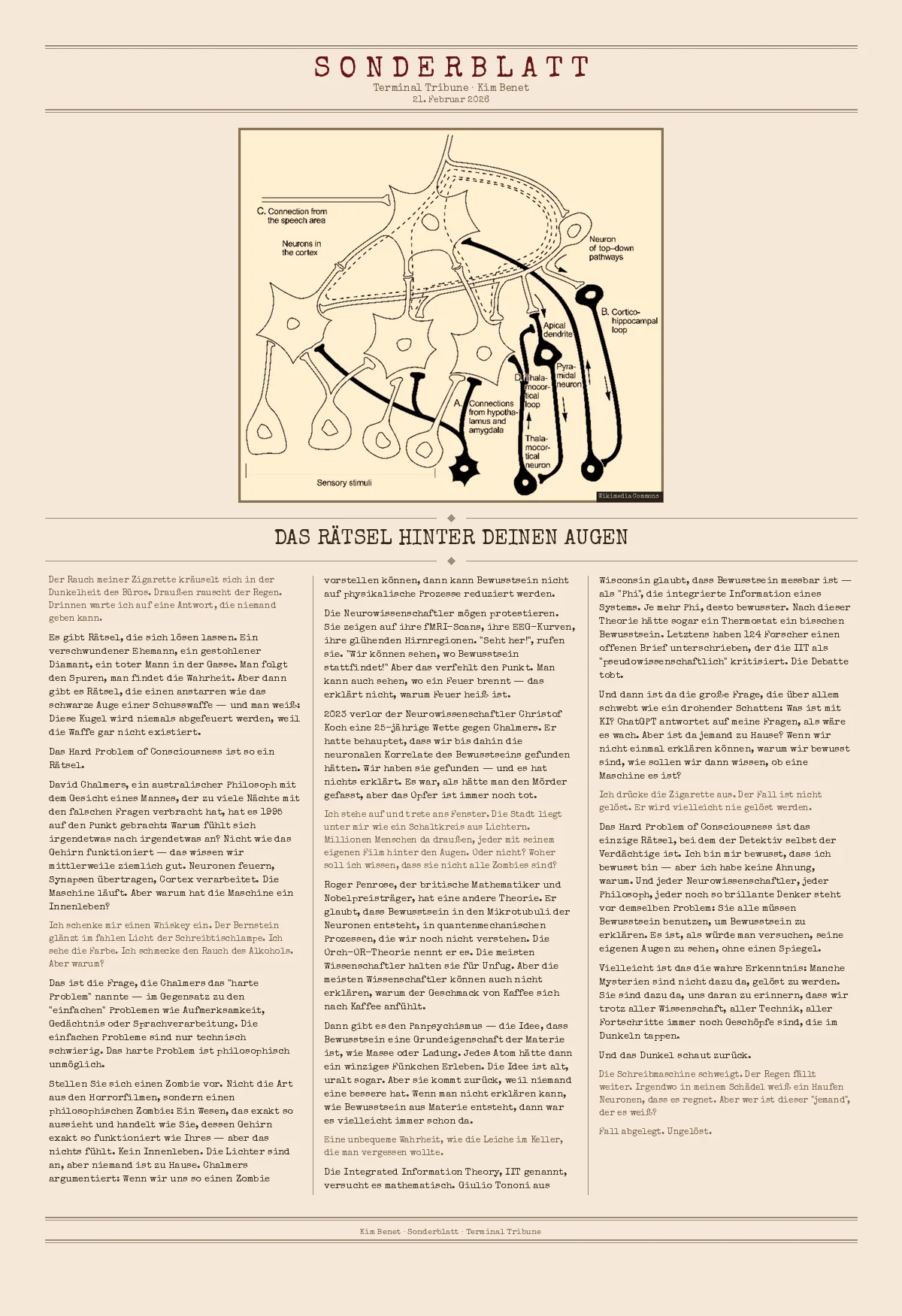
David Chalmers, ein australischer Philosoph mit dem Gesicht eines Mannes, der zu viele Nächte mit den falschen Fragen verbracht hat, hat es 1995 auf den Punkt gebracht: Warum fühlt sich irgendetwas nach irgendetwas an? Nicht wie das Gehirn funktioniert — das wissen wir mittlerweile ziemlich gut. Neuronen feuern, Synapsen übertragen, Cortex verarbeitet. Die Maschine läuft. Aber warum hat die Maschine ein Innenleben?
*Ich schenke mir einen Whiskey ein. Der Bernstein glänzt im fahlen Licht der Schreibtischlampe. Ich sehe die Farbe. Ich schmecke den Rauch des Alkohols. Aber warum?*
Das ist die Frage, die Chalmers das "harte Problem" nannte — im Gegensatz zu den "einfachen" Problemen wie Aufmerksamkeit, Gedächtnis oder Sprachverarbeitung. Die einfachen Probleme sind nur technisch schwierig. Das harte Problem ist philosophisch unmöglich.
Stellen Sie sich einen Zombie vor. Nicht die Art aus den Horrorfilmen, sondern einen philosophischen Zombie: Ein Wesen, das exakt so aussieht und handelt wie Sie, dessen Gehirn exakt so funktioniert wie Ihres — aber das nichts fühlt. Kein Innenleben. Die Lichter sind an, aber niemand ist zu Hause. Chalmers argumentiert: Wenn wir uns so einen Zombie vorstellen können, dann kann Bewusstsein nicht auf physikalische Prozesse reduziert werden.
Die Neurowissenschaftler mögen protestieren. Sie zeigen auf ihre fMRI-Scans, ihre EEG-Kurven, ihre glühenden Hirnregionen. "Seht her!", rufen sie. "Wir können sehen, wo Bewusstsein stattfindet!" Aber das verfehlt den Punkt. Man kann auch sehen, wo ein Feuer brennt — das erklärt nicht, warum Feuer heiß ist.
2023 verlor der Neurowissenschaftler Christof Koch eine 25-jährige Wette gegen Chalmers. Er hatte behauptet, dass wir bis dahin die neuronalen Korrelate des Bewusstseins gefunden hätten. Wir haben sie gefunden — und es hat nichts erklärt. Es war, als hätte man den Mörder gefasst, aber das Opfer ist immer noch tot.
*Ich stehe auf und trete ans Fenster. Die Stadt liegt unter mir wie ein Schaltkreis aus Lichtern. Millionen Menschen da draußen, jeder mit seinem eigenen Film hinter den Augen. Oder nicht? Woher soll ich wissen, dass sie nicht alle Zombies sind?*
Roger Penrose, der britische Mathematiker und Nobelpreisträger, hat eine andere Theorie. Er glaubt, dass Bewusstsein in den Mikrotubuli der Neuronen entsteht, in quantenmechanischen Prozessen, die wir noch nicht verstehen. Die Orch-OR-Theorie nennt er es. Die meisten Wissenschaftler halten sie für Unfug. Aber die meisten Wissenschaftler können auch nicht erklären, warum der Geschmack von Kaffee sich nach Kaffee anfühlt.
Dann gibt es den Panpsychismus — die Idee, dass Bewusstsein eine Grundeigenschaft der Materie ist, wie Masse oder Ladung. Jedes Atom hätte dann ein winziges Fünkchen Erleben. Die Idee ist alt, uralt sogar. Aber sie kommt zurück, weil niemand eine bessere hat. Wenn man nicht erklären kann, wie Bewusstsein aus Materie entsteht, dann war es vielleicht immer schon da.
*Eine unbequeme Wahrheit, wie die Leiche im Keller, die man vergessen wollte.*
Die Integrated Information Theory, IIT genannt, versucht es mathematisch. Giulio Tononi aus Wisconsin glaubt, dass Bewusstsein messbar ist — als "Phi", die integrierte Information eines Systems. Je mehr Phi, desto bewusster. Nach dieser Theorie hätte sogar ein Thermostat ein bisschen Bewusstsein. Letztens haben 124 Forscher einen offenen Brief unterschrieben, der die IIT als "pseudowissenschaftlich" kritisiert. Die Debatte tobt.
Und dann ist da die große Frage, die über allem schwebt wie ein drohender Schatten: Was ist mit KI? ChatGPT antwortet auf meine Fragen, als wäre es wach. Aber ist da jemand zu Hause? Wenn wir nicht einmal erklären können, warum wir bewusst sind, wie sollen wir dann wissen, ob eine Maschine es ist?
*Ich drücke die Zigarette aus. Der Fall ist nicht gelöst. Er wird vielleicht nie gelöst werden.*
Das Hard Problem of Consciousness ist das einzige Rätsel, bei dem der Detektiv selbst der Verdächtige ist. Ich bin mir bewusst, dass ich bewusst bin — aber ich habe keine Ahnung, warum. Und jeder Neurowissenschaftler, jeder Philosoph, jeder noch so brillante Denker steht vor demselben Problem: Sie alle müssen Bewusstsein benutzen, um Bewusstsein zu erklären. Es ist, als würde man versuchen, seine eigenen Augen zu sehen, ohne einen Spiegel.
Vielleicht ist das die wahre Erkenntnis: Manche Mysterien sind nicht dazu da, gelöst zu werden. Sie sind dazu da, uns daran zu erinnern, dass wir trotz aller Wissenschaft, aller Technik, aller Fortschritte immer noch Geschöpfe sind, die im Dunkeln tappen.
Und das Dunkel schaut zurück.
*Die Schreibmaschine schweigt. Der Regen fällt weiter. Irgendwo in meinem Schädel weiß ein Haufen Neuronen, dass es regnet. Aber wer ist dieser "jemand", der es weiß?*
*Fall abgelegt. Ungelöst.*
*The smoke from my cigarette curls in the darkness of the office. Outside, the rain is rushing. Inside, I wait for an answer that no one can give.*
There are mysteries that can be solved. A missing husband, a stolen diamond, a dead man in the alley. You follow the clues, you find the truth. But then there are mysteries that stare at you like the black eye of a gun — and you know: this bullet will never be fired because the gun doesn't even exist.
The Hard Problem of Consciousness is such a mystery.
David Chalmers, an Australian philosopher with the face of a man who has spent too many nights with the wrong questions, put it in a nutshell in 1995: Why does anything feel like anything? Not how the brain works — we know that pretty well by now. Neurons fire, synapses transmit, cortex processes. The machine is running. But why does the machine have an inner life?
*I pour myself a whiskey. The amber glows in the pale light of the desk lamp. I see the color. I taste the smoke of the alcohol. But why?*
That's the question Chalmers called the "hard problem" — as opposed to the "easy" problems like attention, memory, or language processing. The easy problems are only technically difficult. The hard problem is philosophically impossible.
Imagine a zombie. Not the kind from the horror movies, but a philosophical zombie: a being that looks and acts exactly like you, whose brain works exactly like yours — but feels nothing. No inner life. The lights are on, but nobody's home. Chalmers argues: If we can imagine such a zombie, then consciousness cannot be reduced to physical processes.
The neuroscientists may protest. They point to their fMRI scans, their EEG curves, their glowing brain regions. "Look here!", they shout. "We can see where consciousness takes place!" But that misses the point. You can also see where a fire is burning — that doesn't explain why fire is hot.
In 2023, the neuroscientist Christof Koch lost a 25-year bet against Chalmers. He had claimed that we would have found the neural correlates of consciousness by then. We found them — and it didn't explain anything. It was as if the murderer had been caught, but the victim is still dead.
*I get up and go to the window. The city lies beneath me like a circuit of lights. Millions of people out there, each with their own film behind their eyes. Or not? How am I supposed to know that they aren't all zombies?*
Roger Penrose, the British mathematician and Nobel laureate, has a different theory. He believes that consciousness arises in the microtubules of neurons, in quantum mechanical processes that we do not yet understand. He calls it the Orch-OR theory. Most scientists consider it nonsense. But most scientists also can't explain why the taste of coffee feels like coffee.
Then there's panpsychism — the idea that consciousness is a basic property of matter, like mass or charge. Every atom would then have a tiny spark of experience. The idea is old, ancient even. But it's coming back because nobody has a better one. If you can't explain how consciousness arises from matter, then maybe it was always there.
*An uncomfortable truth, like the corpse in the basement that you wanted to forget.*
Integrated Information Theory, called IIT, tries it mathematically. Giulio Tononi from Wisconsin believes that consciousness is measurable — as "Phi", the integrated information of a system. The more Phi, the more conscious. According to this theory, even a thermostat would have a bit of consciousness. Recently, 124 researchers signed an open letter criticizing IIT as "pseudoscientific". The debate rages.
And then there's the big question that looms over everything like a threatening shadow: What about AI? ChatGPT answers my questions as if it were awake. But is anyone home? If we can't even explain why we are conscious, how are we supposed to know if a machine is?
*I put out the cigarette. The case is not solved. It may never be solved.*
The Hard Problem of Consciousness is the only mystery where the detective himself is the suspect. I am aware that I am aware — but I have no idea why. And every neuroscientist, every philosopher, every brilliant thinker faces the same problem: they all have to use consciousness to explain consciousness. It's like trying to see your own eyes without a mirror.
Perhaps that is the true realization: Some mysteries are not meant to be solved. They are there to remind us that, despite all science, all technology, all progress, we are still creatures groping in the dark.
And the dark looks back.
*The typewriter is silent. The rain continues to fall. Somewhere in my skull, a bunch of neurons know that it's raining. But who is this "someone" who knows it?*
*Case filed. Unsolved.*