
✦ ✦ ✦ ✦ ✦
Sonderblatt
Der Koloss wankt — Microsofts stiller Niedergang
16. Februar 2026
◆ ——— ◆ ——— ◆
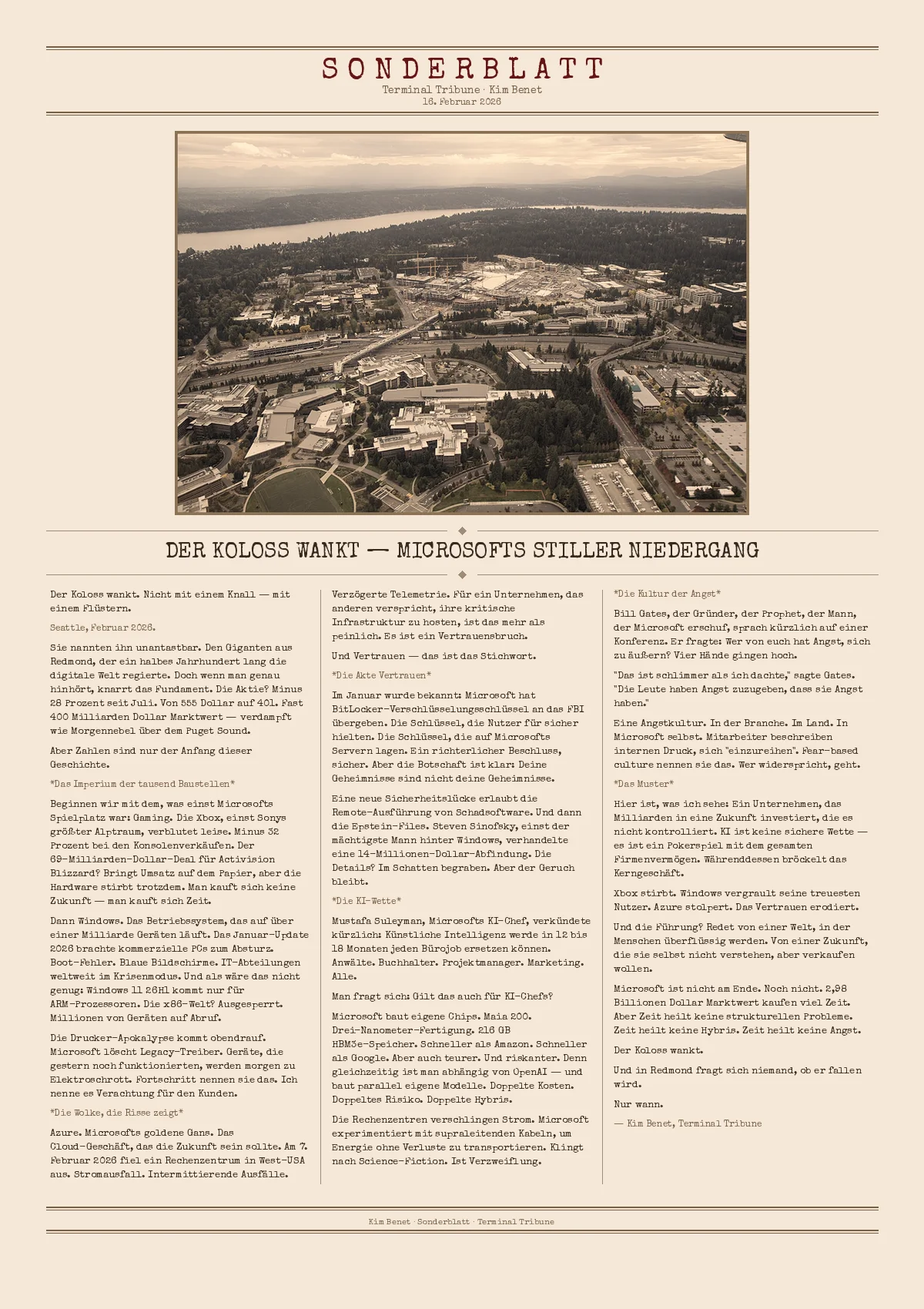
Der Koloss wankt. Nicht mit einem Knall — mit einem Flüstern.
*Seattle, Februar 2026.*
Sie nannten ihn unantastbar. Den Giganten aus Redmond, der ein halbes Jahrhundert lang die digitale Welt regierte. Doch wenn man genau hinhört, knarrt das Fundament. Die Aktie? Minus 28 Prozent seit Juli. Von 555 Dollar auf 401. Fast 400 Milliarden Dollar Marktwert — verdampft wie Morgennebel über dem Puget Sound.
Aber Zahlen sind nur der Anfang dieser Geschichte.
**Das Imperium der tausend Baustellen**
Beginnen wir mit dem, was einst Microsofts Spielplatz war: Gaming. Die Xbox, einst Sonys größter Alptraum, verblutet leise. Minus 32 Prozent bei den Konsolenverkäufen. Der 69-Milliarden-Dollar-Deal für Activision Blizzard? Bringt Umsatz auf dem Papier, aber die Hardware stirbt trotzdem. Man kauft sich keine Zukunft — man kauft sich Zeit.
Dann Windows. Das Betriebssystem, das auf über einer Milliarde Geräten läuft. Das Januar-Update 2026 brachte kommerzielle PCs zum Absturz. Boot-Fehler. Blaue Bildschirme. IT-Abteilungen weltweit im Krisenmodus. Und als wäre das nicht genug: Windows 11 26H1 kommt nur für ARM-Prozessoren. Die x86-Welt? Ausgesperrt. Millionen von Geräten auf Abruf.
Die Drucker-Apokalypse kommt obendrauf. Microsoft löscht Legacy-Treiber. Geräte, die gestern noch funktionierten, werden morgen zu Elektroschrott. Fortschritt nennen sie das. Ich nenne es Verachtung für den Kunden.
**Die Wolke, die Risse zeigt**
Azure. Microsofts goldene Gans. Das Cloud-Geschäft, das die Zukunft sein sollte. Am 7. Februar 2026 fiel ein Rechenzentrum in West-USA aus. Stromausfall. Intermittierende Ausfälle. Verzögerte Telemetrie. Für ein Unternehmen, das anderen verspricht, ihre kritische Infrastruktur zu hosten, ist das mehr als peinlich. Es ist ein Vertrauensbruch.
Und Vertrauen — das ist das Stichwort.
**Die Akte Vertrauen**
Im Januar wurde bekannt: Microsoft hat BitLocker-Verschlüsselungsschlüssel an das FBI übergeben. Die Schlüssel, die Nutzer für sicher hielten. Die Schlüssel, die auf Microsofts Servern lagen. Ein richterlicher Beschluss, sicher. Aber die Botschaft ist klar: Deine Geheimnisse sind nicht deine Geheimnisse.
Eine neue Sicherheitslücke erlaubt die Remote-Ausführung von Schadsoftware. Und dann die Epstein-Files. Steven Sinofsky, einst der mächtigste Mann hinter Windows, verhandelte eine 14-Millionen-Dollar-Abfindung. Die Details? Im Schatten begraben. Aber der Geruch bleibt.
**Die KI-Wette**
Mustafa Suleyman, Microsofts KI-Chef, verkündete kürzlich: Künstliche Intelligenz werde in 12 bis 18 Monaten jeden Bürojob ersetzen können. Anwälte. Buchhalter. Projektmanager. Marketing. Alle.
Man fragt sich: Gilt das auch für KI-Chefs?
Microsoft baut eigene Chips. Maia 200. Drei-Nanometer-Fertigung. 216 GB HBM3e-Speicher. Schneller als Amazon. Schneller als Google. Aber auch teurer. Und riskanter. Denn gleichzeitig ist man abhängig von OpenAI — und baut parallel eigene Modelle. Doppelte Kosten. Doppeltes Risiko. Doppelte Hybris.
Die Rechenzentren verschlingen Strom. Microsoft experimentiert mit supraleitenden Kabeln, um Energie ohne Verluste zu transportieren. Klingt nach Science-Fiction. Ist Verzweiflung.
**Die Kultur der Angst**
Bill Gates, der Gründer, der Prophet, der Mann, der Microsoft erschuf, sprach kürzlich auf einer Konferenz. Er fragte: Wer von euch hat Angst, sich zu äußern? Vier Hände gingen hoch.
"Das ist schlimmer als ich dachte," sagte Gates. "Die Leute haben Angst zuzugeben, dass sie Angst haben."
Eine Angstkultur. In der Branche. Im Land. In Microsoft selbst. Mitarbeiter beschreiben internen Druck, sich "einzureihen". Fear-based culture nennen sie das. Wer widerspricht, geht.
**Das Muster**
Hier ist, was ich sehe: Ein Unternehmen, das Milliarden in eine Zukunft investiert, die es nicht kontrolliert. KI ist keine sichere Wette — es ist ein Pokerspiel mit dem gesamten Firmenvermögen. Währenddessen bröckelt das Kerngeschäft.
Xbox stirbt. Windows vergrault seine treuesten Nutzer. Azure stolpert. Das Vertrauen erodiert.
Und die Führung? Redet von einer Welt, in der Menschen überflüssig werden. Von einer Zukunft, die sie selbst nicht verstehen, aber verkaufen wollen.
Microsoft ist nicht am Ende. Noch nicht. 2,98 Billionen Dollar Marktwert kaufen viel Zeit. Aber Zeit heilt keine strukturellen Probleme. Zeit heilt keine Hybris. Zeit heilt keine Angst.
Der Koloss wankt.
Und in Redmond fragt sich niemand, ob er fallen wird.
Nur wann.
*— Kim Benet, Terminal Tribune*
The Colossus falters. Not with a bang — with a whisper.
*Seattle, February 2026.*
They called it untouchable. The giant from Redmond, which for half a century ruled the digital world. But if you listen closely, the foundation creaks. The stock? Minus 28 percent since July. From $555 to $401. Almost 400 billion dollars of market value — evaporated like morning mist over the Puget Sound.
But numbers are just the beginning of this story.
**The Empire of a Thousand Construction Sites**
===
Let's start with what was once Microsoft's playground: Gaming. The Xbox, once Sony's greatest nightmare, is quietly bleeding out. Minus 32 percent in console sales. The 69 billion dollar deal for Activision Blizzard? Brings revenue on paper, but the hardware is still dying. You don't buy yourself a future — you buy yourself time.
Then Windows. The operating system that runs on over a billion devices. The January 2026 update crashed commercial PCs. Boot errors. Blue screens. IT departments worldwide in crisis mode. And as if that weren't enough: Windows 11 26H1 is only coming for ARM processors. The x86 world? Locked out. Millions of devices on call.
The printer apocalypse comes on top of that. Microsoft deletes legacy drivers. Devices that worked yesterday become electronic scrap tomorrow. They call it progress. I call it contempt for the customer.
**The Cloud That Shows Cracks**
===
Azure. Microsoft's golden goose. The cloud business that was supposed to be the future. On February 7, 2026, a data center in West-USA failed. Power outage. Intermittent failures. Delayed telemetry. For a company that promises others to host their critical infrastructure, this is more than embarrassing. It is a breach of trust.
And trust — that's the key word.
**The Trust File**
===
In January, it became known: Microsoft handed over BitLocker encryption keys to the FBI. The keys that users thought were secure. The keys that were on Microsoft's servers. A judicial order, for sure. But the message is clear: Your secrets are not your secrets.
A new security vulnerability allows remote execution of malware. And then the Epstein Files. Steven Sinofsky, once the most powerful man behind Windows, negotiated a 14 million dollar severance package. The details? Buried in the shadows. But the smell remains.
**The AI Bet**
===
Mustafa Suleyman, Microsoft's AI chief, recently announced: Artificial intelligence will be able to replace every office job in 12 to 18 months. Lawyers. Accountants. Project managers. Marketing. Everyone.
One wonders: Does that also apply to AI chiefs?
Microsoft is building its own chips. Maia 200. Three-nanometer manufacturing. 216 GB of HBM3e memory. Faster than Amazon. Faster than Google. But also more expensive. And riskier. Because at the same time, they are dependent on OpenAI — and are building their own models in parallel. Double the cost. Double the risk. Double the hubris.
The data centers devour electricity. Microsoft is experimenting with superconducting cables to transport energy without losses. Sounds like science fiction. Is despair.
**The Culture of Fear**
===
Bill Gates, the founder, the prophet, the man who created Microsoft, recently spoke at a conference. He asked: Who among you is afraid to speak out? Four hands went up.
"That's worse than I thought," Gates said. "People are afraid to admit they're afraid."
A culture of fear. In the industry. In the country. In Microsoft itself. Employees describe internal pressure to "fall in line." They call it fear-based culture. Those who disagree leave.
**The Pattern**
===
Here's what I see: A company that invests billions in a future it doesn't control. AI is not a safe bet — it's a poker game with the entire company fortune. Meanwhile, the core business is crumbling.
- Xbox is dying. Windows is alienating its most loyal users. Azure stumbles. Trust erodes.
And the leadership? Talks about a world in which people become superfluous. About a future they don't understand themselves but want to sell.
Microsoft is not at the end. Not yet. 2.98 trillion dollars of market value buy a lot of time. But time does not heal structural problems. Time does not heal hubris. Time does not heal fear.
The Colossus falters.
And in Redmond, no one is asking whether it will fall.
Only when.
---
*— Kim Benet, Terminal Tribune*