
✦ ✦ ✦ ✦ ✦
Sonderblatt
Die Kathedrale der Stille — Der LHC und das Schweigen des Universums
16. Februar 2026
◆ ——— ◆ ——— ◆
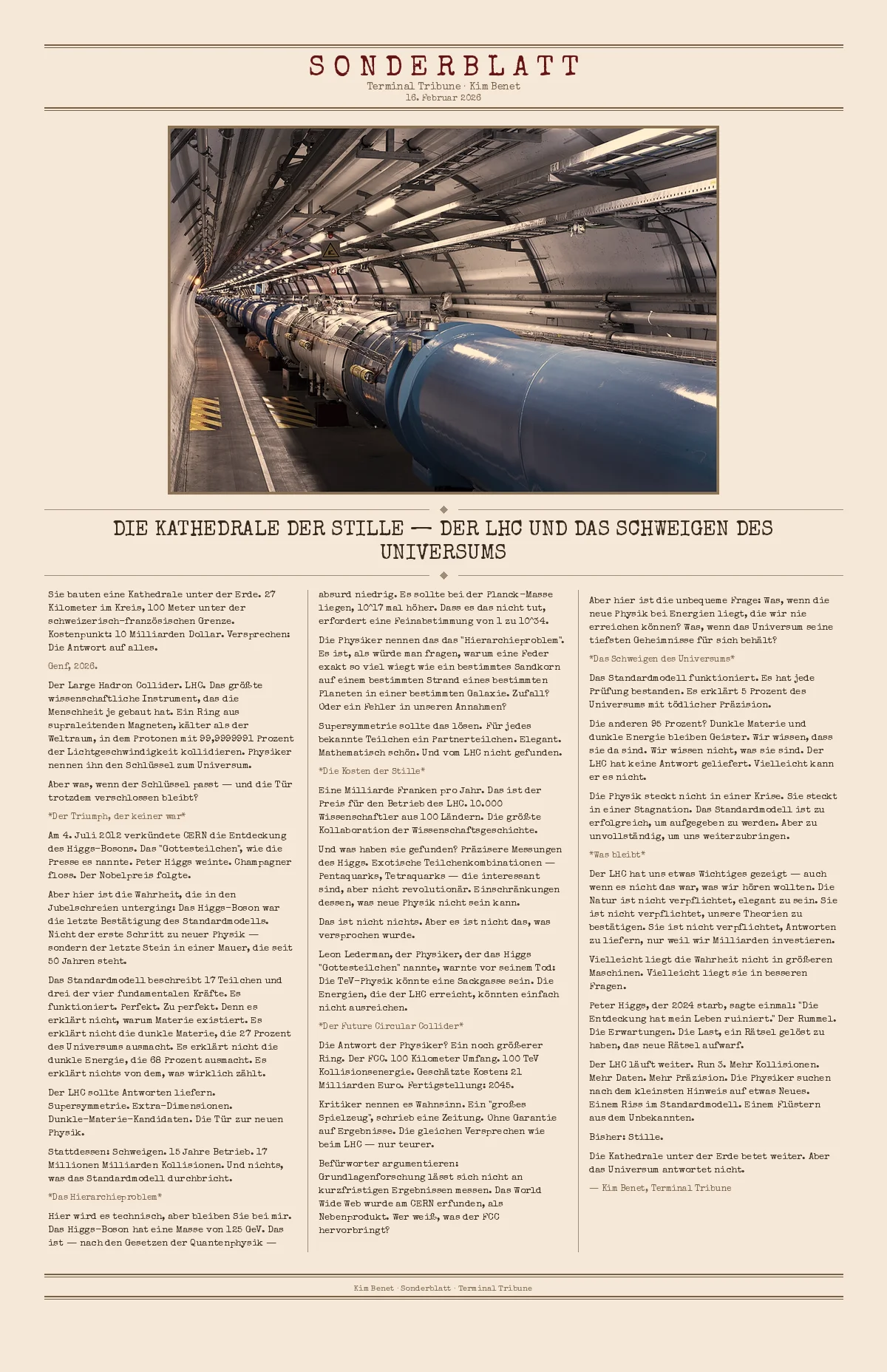
Sie bauten eine Kathedrale unter der Erde. 27 Kilometer im Kreis, 100 Meter unter der schweizerisch-französischen Grenze. Kostenpunkt: 10 Milliarden Dollar. Versprechen: Die Antwort auf alles.
*Genf, 2026.*
Der Large Hadron Collider. LHC. Das größte wissenschaftliche Instrument, das die Menschheit je gebaut hat. Ein Ring aus supraleitenden Magneten, kälter als der Weltraum, in dem Protonen mit 99,9999991 Prozent der Lichtgeschwindigkeit kollidieren. Physiker nennen ihn den Schlüssel zum Universum.
Aber was, wenn der Schlüssel passt — und die Tür trotzdem verschlossen bleibt?
**Der Triumph, der keiner war**
Am 4. Juli 2012 verkündete CERN die Entdeckung des Higgs-Bosons. Das "Gottesteilchen", wie die Presse es nannte. Peter Higgs weinte. Champagner floss. Der Nobelpreis folgte.
Aber hier ist die Wahrheit, die in den Jubelschreien unterging: Das Higgs-Boson war die letzte Bestätigung des Standardmodells. Nicht der erste Schritt zu neuer Physik — sondern der letzte Stein in einer Mauer, die seit 50 Jahren steht.
Das Standardmodell beschreibt 17 Teilchen und drei der vier fundamentalen Kräfte. Es funktioniert. Perfekt. Zu perfekt. Denn es erklärt nicht, warum Materie existiert. Es erklärt nicht die dunkle Materie, die 27 Prozent des Universums ausmacht. Es erklärt nicht die dunkle Energie, die 68 Prozent ausmacht. Es erklärt nichts von dem, was wirklich zählt.
Der LHC sollte Antworten liefern. Supersymmetrie. Extra-Dimensionen. Dunkle-Materie-Kandidaten. Die Tür zur neuen Physik.
Stattdessen: Schweigen. 15 Jahre Betrieb. 17 Millionen Milliarden Kollisionen. Und nichts, was das Standardmodell durchbricht.
**Das Hierarchieproblem**
Hier wird es technisch, aber bleiben Sie bei mir. Das Higgs-Boson hat eine Masse von 125 GeV. Das ist — nach den Gesetzen der Quantenphysik — absurd niedrig. Es sollte bei der Planck-Masse liegen, 10^17 mal höher. Dass es das nicht tut, erfordert eine Feinabstimmung von 1 zu 10^34.
Die Physiker nennen das das "Hierarchieproblem". Es ist, als würde man fragen, warum eine Feder exakt so viel wiegt wie ein bestimmtes Sandkorn auf einem bestimmten Strand eines bestimmten Planeten in einer bestimmten Galaxie. Zufall? Oder ein Fehler in unseren Annahmen?
Supersymmetrie sollte das lösen. Für jedes bekannte Teilchen ein Partnerteilchen. Elegant. Mathematisch schön. Und vom LHC nicht gefunden.
**Die Kosten der Stille**
Eine Milliarde Franken pro Jahr. Das ist der Preis für den Betrieb des LHC. 10.000 Wissenschaftler aus 100 Ländern. Die größte Kollaboration der Wissenschaftsgeschichte.
Und was haben sie gefunden? Präzisere Messungen des Higgs. Exotische Teilchenkombinationen — Pentaquarks, Tetraquarks — die interessant sind, aber nicht revolutionär. Einschränkungen dessen, was neue Physik nicht sein kann.
Das ist nicht nichts. Aber es ist nicht das, was versprochen wurde.
Leon Lederman, der Physiker, der das Higgs "Gottesteilchen" nannte, warnte vor seinem Tod: Die TeV-Physik könnte eine Sackgasse sein. Die Energien, die der LHC erreicht, könnten einfach nicht ausreichen.
**Der Future Circular Collider**
Die Antwort der Physiker? Ein noch größerer Ring. Der FCC. 100 Kilometer Umfang. 100 TeV Kollisionsenergie. Geschätzte Kosten: 21 Milliarden Euro. Fertigstellung: 2045.
Kritiker nennen es Wahnsinn. Ein "großes Spielzeug", schrieb eine Zeitung. Ohne Garantie auf Ergebnisse. Die gleichen Versprechen wie beim LHC — nur teurer.
Befürworter argumentieren: Grundlagenforschung lässt sich nicht an kurzfristigen Ergebnissen messen. Das World Wide Web wurde am CERN erfunden, als Nebenprodukt. Wer weiß, was der FCC hervorbringt?
Aber hier ist die unbequeme Frage: Was, wenn die neue Physik bei Energien liegt, die wir nie erreichen können? Was, wenn das Universum seine tiefsten Geheimnisse für sich behält?
**Das Schweigen des Universums**
Das Standardmodell funktioniert. Es hat jede Prüfung bestanden. Es erklärt 5 Prozent des Universums mit tödlicher Präzision.
Die anderen 95 Prozent? Dunkle Materie und dunkle Energie bleiben Geister. Wir wissen, dass sie da sind. Wir wissen nicht, was sie sind. Der LHC hat keine Antwort geliefert. Vielleicht kann er es nicht.
Die Physik steckt nicht in einer Krise. Sie steckt in einer Stagnation. Das Standardmodell ist zu erfolgreich, um aufgegeben zu werden. Aber zu unvollständig, um uns weiterzubringen.
**Was bleibt**
Der LHC hat uns etwas Wichtiges gezeigt — auch wenn es nicht das war, was wir hören wollten. Die Natur ist nicht verpflichtet, elegant zu sein. Sie ist nicht verpflichtet, unsere Theorien zu bestätigen. Sie ist nicht verpflichtet, Antworten zu liefern, nur weil wir Milliarden investieren.
Vielleicht liegt die Wahrheit nicht in größeren Maschinen. Vielleicht liegt sie in besseren Fragen.
Peter Higgs, der 2024 starb, sagte einmal: "Die Entdeckung hat mein Leben ruiniert." Der Rummel. Die Erwartungen. Die Last, ein Rätsel gelöst zu haben, das neue Rätsel aufwarf.
Der LHC läuft weiter. Run 3. Mehr Kollisionen. Mehr Daten. Mehr Präzision. Die Physiker suchen nach dem kleinsten Hinweis auf etwas Neues. Einem Riss im Standardmodell. Einem Flüstern aus dem Unbekannten.
Bisher: Stille.
Die Kathedrale unter der Erde betet weiter. Aber das Universum antwortet nicht.
*— Kim Benet, Terminal Tribune*
They built a cathedral under the earth. 27 kilometers in circumference, 100 meters below the Swiss-French border. Cost: 10 billion dollars. Promise: The answer to everything.
*Geneva, 2026.*
The Large Hadron Collider. LHC. The largest scientific instrument ever built by mankind. A ring of superconducting magnets, colder than space, in which protons collide at 99.9999991 percent of the speed of light. Physicists call it the key to the universe.
But what if the key fits—and the door remains locked?
**The Triumph That Wasn't**
===
On July 4, 2012, CERN announced the discovery of the Higgs boson. The "God particle," as the press called it. Peter Higgs wept. Champagne flowed. The Nobel Prize followed.
But here is the truth that was lost in the cheers: The Higgs boson was the final confirmation of the Standard Model. Not the first step to new physics—but the last stone in a wall that has stood for 50 years.
The Standard Model describes 17 particles and three of the four fundamental forces. It works. Perfectly. Too perfectly. Because it does not explain why matter exists. It does not explain the dark matter that makes up 27 percent of the universe. It does not explain the dark energy that makes up 68 percent. It explains nothing of what really matters.
The LHC was supposed to provide answers. Supersymmetry. Extra dimensions. Dark matter candidates. The door to new physics.
Instead: Silence. 15 years of operation. 17 million billion collisions. And nothing that breaks through the Standard Model.
**The Hierarchy Problem**
===
This is where it gets technical, but stay with me. The Higgs boson has a mass of 125 GeV. That is—according to the laws of quantum physics—absurdly low. It should be at the Planck mass, 10^17 times higher. The fact that it doesn't requires a fine-tuning of 1 in 10^34.
Physicists call this the "hierarchy problem." It's like asking why a feather weighs exactly as much as a particular grain of sand on a particular beach on a particular planet in a particular galaxy. Coincidence? Or a flaw in our assumptions?
Supersymmetry was supposed to solve this. For every known particle, a partner particle. Elegant. Mathematically beautiful. And not found by the LHC.
**The Cost of Silence**
===
One billion francs per year. That is the price of operating the LHC. 10,000 scientists from 100 countries. The largest collaboration in the history of science.
And what have they found? More precise measurements of the Higgs. Exotic particle combinations—pentaquarks, tetraquarks—that are interesting but not revolutionary. Restrictions on what new physics cannot be.
That's not nothing. But it's not what was promised.
Leon Lederman, the physicist who called the Higgs the "God particle," warned before his death: TeV physics could be a dead end. The energies that the LHC reaches may simply not be sufficient.
**The Future Circular Collider**
===
The physicists' answer? An even larger ring. The FCC. 100 kilometers in circumference. 100 TeV collision energy. Estimated cost: 21 billion euros. Completion: 2045.
Critics call it madness. A "big toy," one newspaper wrote. Without a guarantee of results. The same promises as with the LHC—only more expensive.
Proponents argue: basic research cannot be measured by short-term results. The World Wide Web was invented at CERN as a byproduct. Who knows what the FCC will produce?
But here is the uncomfortable question: What if the new physics lies at energies that we can never reach? What if the universe keeps its deepest secrets to itself?
**The Silence of the Universe**
===
The Standard Model works. It has passed every test. It explains 5 percent of the universe with deadly precision.
The other 95 percent? Dark matter and dark energy remain ghosts. We know they are there. We do not know what they are. The LHC has provided no answer. Perhaps it cannot.
Physics is not in a crisis. It is in a stagnation. The Standard Model is too successful to be abandoned. But too incomplete to take us further.
**What Remains**
===
The LHC has shown us something important—even if it wasn't what we wanted to hear. Nature is not obliged to be elegant. It is not obliged to confirm our theories. It is not obliged to provide answers just because we invest billions.
Perhaps the truth lies not in bigger machines. Perhaps it lies in better questions.
Peter Higgs, who died in 2024, once said: "The discovery ruined my life." The hype. The expectations. The burden of having solved a riddle that raised new riddles.
The LHC continues to run. Run 3. More collisions. More data. More precision. The physicists are looking for the smallest hint of something new. A crack in the Standard Model. A whisper from the unknown.
So far: Silence.
The cathedral under the earth continues to pray. But the universe does not answer.
---
*— Kim Benet, Terminal Tribune*