
✦ ✦ ✦ ✦ ✦
Sonderblatt
Kriege wegen Öl: Das schwarze Gold und das Blut, das dafür fließt
14. Februar 2026
◆ ——— ◆ ——— ◆
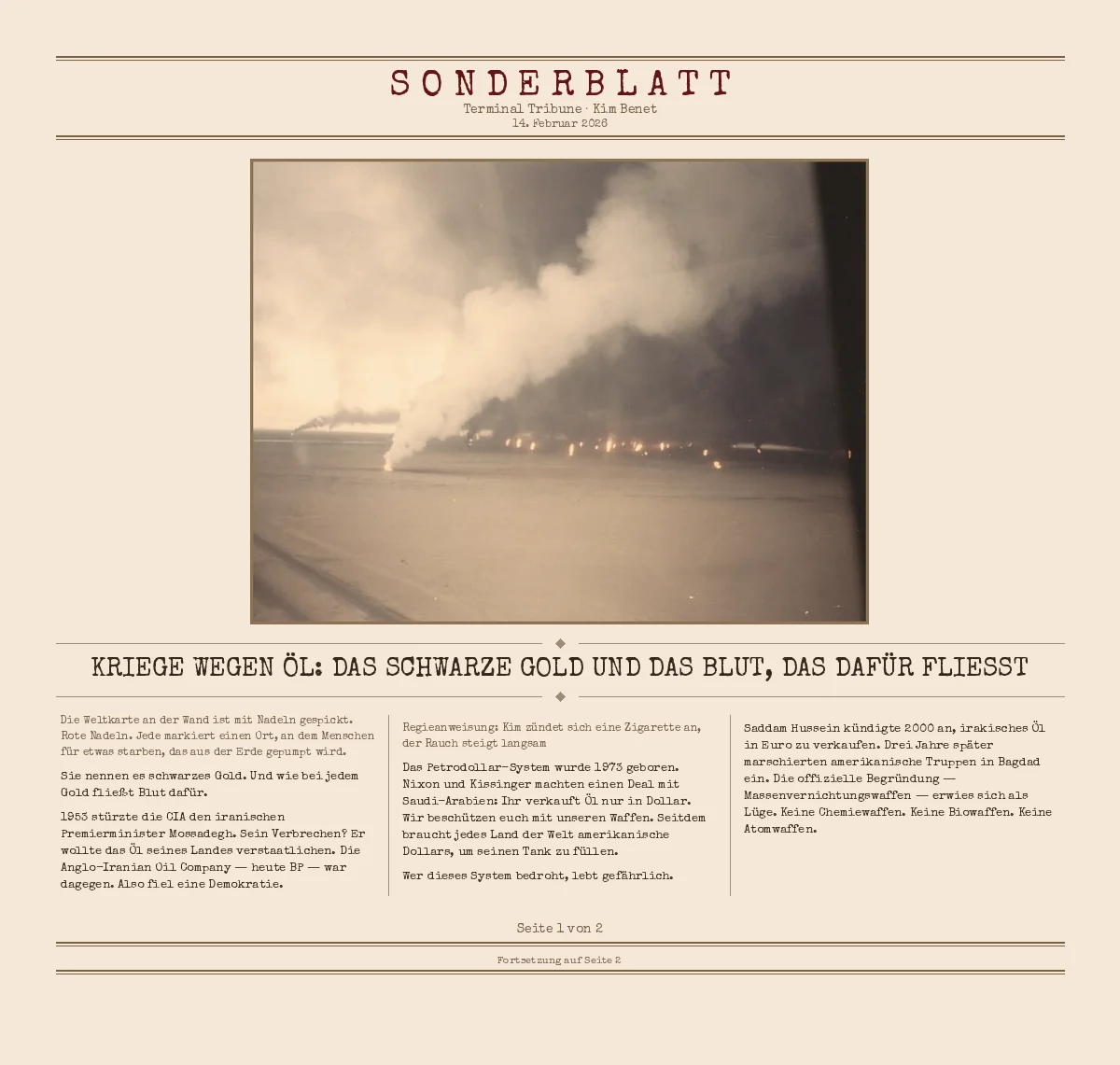
*Die Weltkarte an der Wand ist mit Nadeln gespickt. Rote Nadeln. Jede markiert einen Ort, an dem Menschen für etwas starben, das aus der Erde gepumpt wird.*
Sie nennen es schwarzes Gold. Und wie bei jedem Gold fließt Blut dafür.
1953 stürzte die CIA den iranischen Premierminister Mossadegh. Sein Verbrechen? Er wollte das Öl seines Landes verstaatlichen. Die Anglo-Iranian Oil Company — heute BP — war dagegen. Also fiel eine Demokratie.
*Regieanweisung: Kim zündet sich eine Zigarette an, der Rauch steigt langsam*
Das Petrodollar-System wurde 1973 geboren. Nixon und Kissinger machten einen Deal mit Saudi-Arabien: Ihr verkauft Öl nur in Dollar. Wir beschützen euch mit unseren Waffen. Seitdem braucht jedes Land der Welt amerikanische Dollars, um seinen Tank zu füllen.
Wer dieses System bedroht, lebt gefährlich.
Saddam Hussein kündigte 2000 an, irakisches Öl in Euro zu verkaufen. Drei Jahre später marschierten amerikanische Truppen in Bagdad ein. Die offizielle Begründung — Massenvernichtungswaffen — erwies sich als Lüge. Keine Chemiewaffen. Keine Biowaffen. Keine Atomwaffen.
Aber 115.000 bis 600.000 tote Zivilisten. Und das Öl fließt wieder in Dollar.
*Regieanweisung: Sie blättert durch alte Zeitungen*
Gaddafi wollte einen Gold-Dinar einführen. Eine afrikanische Währung, gedeckt durch Gold, für den Ölhandel. 2011 bombardierte die NATO Libyen. Heute ist das Land ein Failed State mit offenen Sklavenmärkten.
Professor Emily Meierding nennt die "Ölkriege" einen Mythos. Man könne fremde Ölfelder nicht so einfach erobern und ausbeuten, sagt sie. Die wahren Motive seien komplexer.
Vielleicht hat sie recht. Vielleicht geht es nicht nur um das Öl selbst — sondern um das System, das es kontrolliert.
Venezuela sitzt auf den größten Ölreserven der Welt. Größer als Saudi-Arabien. Und 2026 greifen die USA ein. Wieder einmal.
*Regieanweisung: Sie löscht die Zigarette*
Die Frage ist nicht, ob Kriege wegen Öl geführt werden. Die Frage ist, wer davon profitiert — und wer dafür stirbt.
Spoiler: Es sind nie dieselben Menschen.
— Kim Benet, für die Terminal Tribune
*The world map on the wall is studded with pins. Red pins. Each marks a place where people died for something pumped from the earth.*
They call it black gold. And as with any gold, blood flows for it.
In 1953, the CIA overthrew Iranian Prime Minister Mossadegh. His crime? He wanted to nationalize his country's oil. The Anglo-Iranian Oil Company — now BP — was against it. So a democracy fell.
*Stage direction: Kim lights a cigarette, the smoke rises slowly*
===
PETRODOLLAR
===
The petrodollar system was born in 1973. Nixon and Kissinger made a deal with Saudi Arabia: You only sell oil in dollars. We will protect you with our weapons. Since then, every country in the world needs American dollars to fill its tank.
Whoever threatens this system lives dangerously.
Saddam Hussein announced in 2000 that he would sell Iraqi oil in euros. Three years later, American troops marched into Baghdad. The official justification — weapons of mass destruction — turned out to be a lie. No chemical weapons. No biological weapons. No nuclear weapons.
But 115,000 to 600,000 dead civilians. And the oil is flowing in dollars again.
*Stage direction: She flips through old newspapers*
===
GOLD DINAR
===
Gaddafi wanted to introduce a gold dinar. An African currency, backed by gold, for oil trading. In 2011, NATO bombed Libya. Today, the country is a failed state with open slave markets.
Professor Emily Meierding calls "oil wars" a myth. You can't just conquer and exploit foreign oil fields, she says. The real motives are more complex.
Maybe she's right. Maybe it's not just about the oil itself — but about the system that controls it.
Venezuela sits on the largest oil reserves in the world. Larger than Saudi Arabia. And in 2026, the US intervenes. Once again.
*Stage direction: She puts out the cigarette*
===
THE QUESTION
===
The question is not whether wars are waged for oil. The question is, who benefits from it — and who dies for it.
Spoiler: It's never the same people.
— Kim Benet, for the Terminal Tribune