
✦ ✦ ✦ ✦ ✦
Sonderblatt
Puma Punku: Die Steine, die nicht sein dürften
13. Februar 2026
◆ ——— ◆ ——— ◆
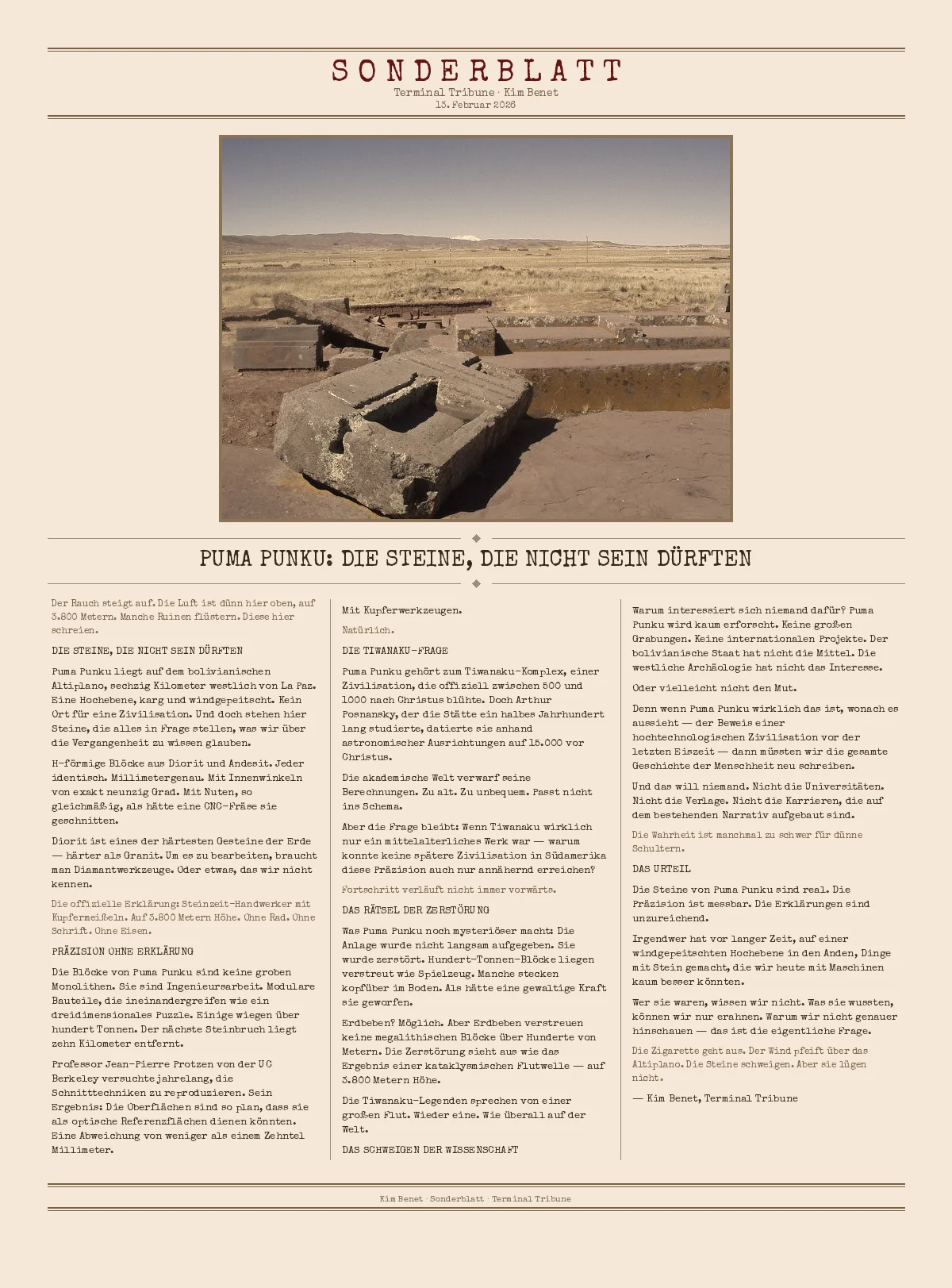
*Der Rauch steigt auf. Die Luft ist dünn hier oben, auf 3.800 Metern. Manche Ruinen flüstern. Diese hier schreien.*
DIE STEINE, DIE NICHT SEIN DÜRFTEN
Puma Punku liegt auf dem bolivianischen Altiplano, sechzig Kilometer westlich von La Paz. Eine Hochebene, karg und windgepeitscht. Kein Ort für eine Zivilisation. Und doch stehen hier Steine, die alles in Frage stellen, was wir über die Vergangenheit zu wissen glauben.
H-förmige Blöcke aus Diorit und Andesit. Jeder identisch. Millimetergenau. Mit Innenwinkeln von exakt neunzig Grad. Mit Nuten, so gleichmäßig, als hätte eine CNC-Fräse sie geschnitten.
Diorit ist eines der härtesten Gesteine der Erde — härter als Granit. Um es zu bearbeiten, braucht man Diamantwerkzeuge. Oder etwas, das wir nicht kennen.
*Die offizielle Erklärung: Steinzeit-Handwerker mit Kupfermeißeln. Auf 3.800 Metern Höhe. Ohne Rad. Ohne Schrift. Ohne Eisen.*
PRÄZISION OHNE ERKLÄRUNG
Die Blöcke von Puma Punku sind keine groben Monolithen. Sie sind Ingenieursarbeit. Modulare Bauteile, die ineinandergreifen wie ein dreidimensionales Puzzle. Einige wiegen über hundert Tonnen. Der nächste Steinbruch liegt zehn Kilometer entfernt.
Professor Jean-Pierre Protzen von der UC Berkeley versuchte jahrelang, die Schnitttechniken zu reproduzieren. Sein Ergebnis: Die Oberflächen sind so plan, dass sie als optische Referenzflächen dienen könnten. Eine Abweichung von weniger als einem Zehntel Millimeter.
Mit Kupferwerkzeugen.
*Natürlich.*
DIE TIWANAKU-FRAGE
Puma Punku gehört zum Tiwanaku-Komplex, einer Zivilisation, die offiziell zwischen 500 und 1000 nach Christus blühte. Doch Arthur Posnansky, der die Stätte ein halbes Jahrhundert lang studierte, datierte sie anhand astronomischer Ausrichtungen auf 15.000 vor Christus.
Die akademische Welt verwarf seine Berechnungen. Zu alt. Zu unbequem. Passt nicht ins Schema.
Aber die Frage bleibt: Wenn Tiwanaku wirklich nur ein mittelalterliches Werk war — warum konnte keine spätere Zivilisation in Südamerika diese Präzision auch nur annähernd erreichen?
*Fortschritt verläuft nicht immer vorwärts.*
DAS RÄTSEL DER ZERSTÖRUNG
Was Puma Punku noch mysteriöser macht: Die Anlage wurde nicht langsam aufgegeben. Sie wurde zerstört. Hundert-Tonnen-Blöcke liegen verstreut wie Spielzeug. Manche stecken kopfüber im Boden. Als hätte eine gewaltige Kraft sie geworfen.
Erdbeben? Möglich. Aber Erdbeben verstreuen keine megalithischen Blöcke über Hunderte von Metern. Die Zerstörung sieht aus wie das Ergebnis einer kataklysmischen Flutwelle — auf 3.800 Metern Höhe.
Die Tiwanaku-Legenden sprechen von einer großen Flut. Wieder eine. Wie überall auf der Welt.
DAS SCHWEIGEN DER WISSENSCHAFT
Warum interessiert sich niemand dafür? Puma Punku wird kaum erforscht. Keine großen Grabungen. Keine internationalen Projekte. Der bolivianische Staat hat nicht die Mittel. Die westliche Archäologie hat nicht das Interesse.
Oder vielleicht nicht den Mut.
Denn wenn Puma Punku wirklich das ist, wonach es aussieht — der Beweis einer hochtechnologischen Zivilisation vor der letzten Eiszeit — dann müssten wir die gesamte Geschichte der Menschheit neu schreiben.
Und das will niemand. Nicht die Universitäten. Nicht die Verlage. Nicht die Karrieren, die auf dem bestehenden Narrativ aufgebaut sind.
*Die Wahrheit ist manchmal zu schwer für dünne Schultern.*
DAS URTEIL
Die Steine von Puma Punku sind real. Die Präzision ist messbar. Die Erklärungen sind unzureichend.
Irgendwer hat vor langer Zeit, auf einer windgepeitschten Hochebene in den Anden, Dinge mit Stein gemacht, die wir heute mit Maschinen kaum besser könnten.
Wer sie waren, wissen wir nicht. Was sie wussten, können wir nur erahnen. Warum wir nicht genauer hinschauen — das ist die eigentliche Frage.
*Die Zigarette geht aus. Der Wind pfeift über das Altiplano. Die Steine schweigen. Aber sie lügen nicht.*
— Kim Benet, Terminal Tribune
*The smoke rises. The air is thin up here, at 3,800 meters. Some ruins whisper. These ones scream.*
THE STONES THAT SHOULD NOT BE
Puma Punku lies on the Bolivian Altiplano, sixty kilometers west of La Paz. A high plateau, barren and windswept. Not a place for a civilization. And yet here stand stones that call into question everything we think we know about the past.
H-shaped blocks of diorite and andesite. Each identical. Millimeter-precise. With interior angles of exactly ninety degrees. With grooves so uniform, as if a CNC milling machine had cut them.
Diorite is one of the hardest rocks on earth — harder than granite. To work it, you need diamond tools. Or something we don't know.
*The official explanation: Stone Age craftsmen with copper chisels. At an altitude of 3,800 meters. Without a wheel. Without writing. Without iron.*
===
PRECISION WITHOUT EXPLANATION
===
The blocks of Puma Punku are not rough monoliths. They are engineering work. Modular components that interlock like a three-dimensional puzzle. Some weigh over a hundred tons. The nearest quarry is ten kilometers away.
Professor Jean-Pierre Protzen of UC Berkeley spent years trying to reproduce the cutting techniques. His result: The surfaces are so flat that they could serve as optical reference surfaces. A deviation of less than a tenth of a millimeter.
With copper tools.
*Naturally.*
===
THE TIWANAKU QUESTION
===
Puma Punku belongs to the Tiwanaku complex, a civilization that officially flourished between 500 and 1000 AD. But Arthur Posnansky, who studied the site for half a century, dated it to 15,000 BC based on astronomical alignments.
The academic world rejected his calculations. Too old. Too inconvenient. Doesn't fit the pattern.
But the question remains: If Tiwanaku was really just a medieval work — why couldn't any later civilization in South America even come close to achieving this precision?
*Progress does not always move forward.*
---
===
THE RIDDLE OF DESTRUCTION
===
What makes Puma Punku even more mysterious: The site was not slowly abandoned. It was destroyed. Hundred-ton blocks lie scattered like toys. Some are stuck upside down in the ground. As if a massive force had thrown them.
Earthquake? Possibly. But earthquakes don't scatter megalithic blocks over hundreds of meters. The destruction looks like the result of a cataclysmic tidal wave — at an altitude of 3,800 meters.
The Tiwanaku legends speak of a great flood. Another one. Like everywhere else in the world.
===
THE SILENCE OF SCIENCE
===
Why is nobody interested in this? Puma Punku is hardly explored. No major excavations. No international projects. The Bolivian state does not have the means. Western archaeology has no interest.
Or perhaps not the courage.
Because if Puma Punku really is what it looks like — the proof of a highly technological civilization before the last ice age — then we would have to rewrite the entire history of mankind.
And nobody wants that. Not the universities. Not the publishers. Not the careers that are built on the existing narrative.
*The truth is sometimes too heavy for thin shoulders.*
===
THE VERDICT
===
The stones of Puma Punku are real. The precision is measurable. The explanations are inadequate.
Someone, long ago, on a windswept plateau in the Andes, did things with stone that we could hardly do better with machines today.
Who they were, we do not know. What they knew, we can only guess. Why we don't look more closely — that is the real question.
*The cigarette goes out. The wind whistles across the Altiplano. The stones are silent. But they do not lie.*
— Kim Benet, Terminal Tribune
---