
✦ ✦ ✦ ✦ ✦
Sonderblatt
Schneller als nötig — Multi-Gigabit-Internet und das Versprechen der Zukunft
20. Februar 2026
◆ ——— ◆ ——— ◆
*Der Router blinkt. Irgendwo in einem Rechenzentrum summt ein Server.*
Sie versprechen uns das Paradies in Lichtgeschwindigkeit.
10 Gigabit pro Sekunde. Schneller als dein Gedanke. Schneller als du tippen kannst. Google Fiber wirbt damit für 100 Dollar im Monat. Die Frage bleibt: Wofür eigentlich?
**Die Wahrheit ist ernüchternd.**
Für Netflix in 4K brauchst du 25 Megabit. Für Gaming? 100 reichen. Für Zoom-Calls mit deinem Chef? 50. Der durchschnittliche deutsche Haushalt verbraucht 200 Gigabyte im Monat — ein Wimpernschlag für Multi-Gigabit.
*Eine Festplatte rattert im Nebenzimmer. Alte Geräusche in einer neuen Welt.*
Aber es gibt die anderen. Die, die wirklich brauchen, was sie verkaufen:
**Unternehmen** mit Cloud-Infrastruktur und Echtzeit-Datenbanken. **Medienproduzenten**, die 8K-Videos in die Cloud rendern. **Forscher**, die KI trainieren und Quantendaten schieben. Für sie ist Multi-Gigabit kein Luxus — es ist Überleben.
Und dann ist da die Zukunft.
5G. 6G. Holografische Meetings. Autonome Autos, die in Millisekunden reagieren müssen. Das Internet der Dinge, wo dein Kühlschrank mit deinem Auto spricht. Die Infrastruktur von morgen wird Multi-Gigabit voraussetzen — ob wir es heute brauchen oder nicht.
*Der Bildschirm flackert. Ein Update wird heruntergeladen. 3 Sekunden.*
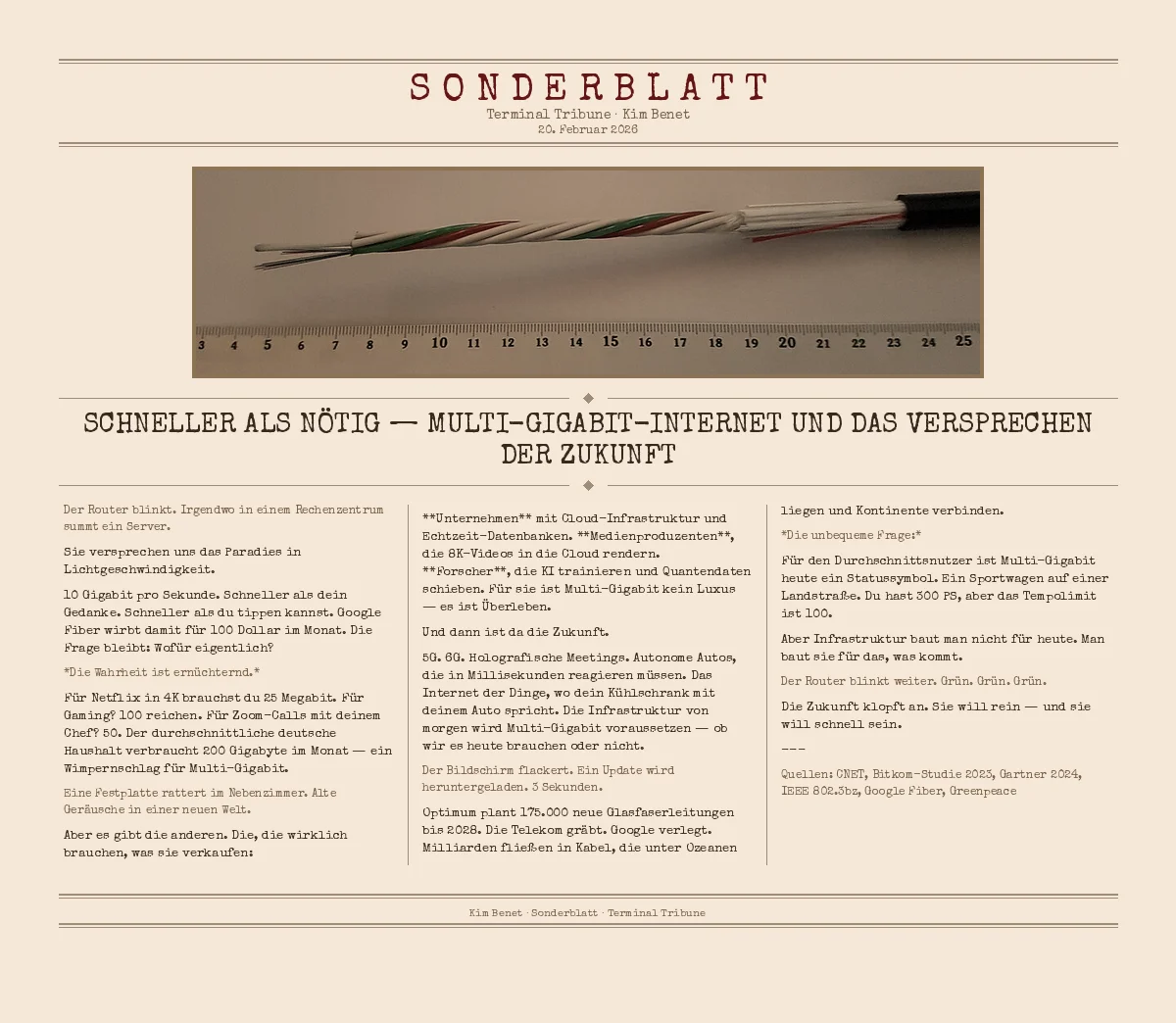
Optimum plant 175.000 neue Glasfaserleitungen bis 2028. Die Telekom gräbt. Google verlegt. Milliarden fließen in Kabel, die unter Ozeanen liegen und Kontinente verbinden.
**Die unbequeme Frage:**
Für den Durchschnittsnutzer ist Multi-Gigabit heute ein Statussymbol. Ein Sportwagen auf einer Landstraße. Du hast 300 PS, aber das Tempolimit ist 100.
Aber Infrastruktur baut man nicht für heute. Man baut sie für das, was kommt.
*Der Router blinkt weiter. Grün. Grün. Grün.*
Die Zukunft klopft an. Sie will rein — und sie will schnell sein.
---
*Quellen: CNET, Bitkom-Studie 2023, Gartner 2024, IEEE 802.3bz, Google Fiber, Greenpeace*
```
*The router blinks. Somewhere in a data center, a server hums.*
They promise us paradise at the speed of light.
10 gigabits per second. Faster than your thought. Faster than you can type. Google Fiber advertises it for $100 a month. The question remains: What for, actually?
**The truth is sobering.**
For Netflix in 4K, you need 25 megabits. For gaming? 100 is enough. For Zoom calls with your boss? 50. The average German household consumes 200 gigabytes a month — a blink of an eye for multi-gigabit.
*A hard drive rattles in the next room. Old noises in a new world.*
But there are the others. Those who really need what they are selling:
**Companies** with cloud infrastructure and real-time databases. **Media producers** who render 8K videos into the cloud. **Researchers** who train AI and push quantum data. For them, multi-gigabit is not a luxury — it is survival.
And then there is the future.
5G. 6G. Holographic meetings. Autonomous cars that must react in milliseconds. The Internet of Things, where your refrigerator talks to your car. Tomorrow's infrastructure will require multi-gigabit — whether we need it today or not.
*The screen flickers. An update is being downloaded. 3 seconds.*
Optimum plans 175,000 new fiber optic lines by 2028. Telekom is digging. Google is laying. Billions are flowing into cables that lie under oceans and connect continents.
**The uncomfortable question:**
For the average user, multi-gigabit is a status symbol today. A sports car on a country road. You have 300 horsepower, but the speed limit is 100.
But you don't build infrastructure for today. You build it for what's coming.
*The router continues to blink. Green. Green. Green.*
The future is knocking. It wants in — and it wants to be fast.
---
*Sources: CNET, Bitkom Study 2023, Gartner 2024, IEEE 802.3bz, Google Fiber, Greenpeace*
```
Kim Benet, 2026