
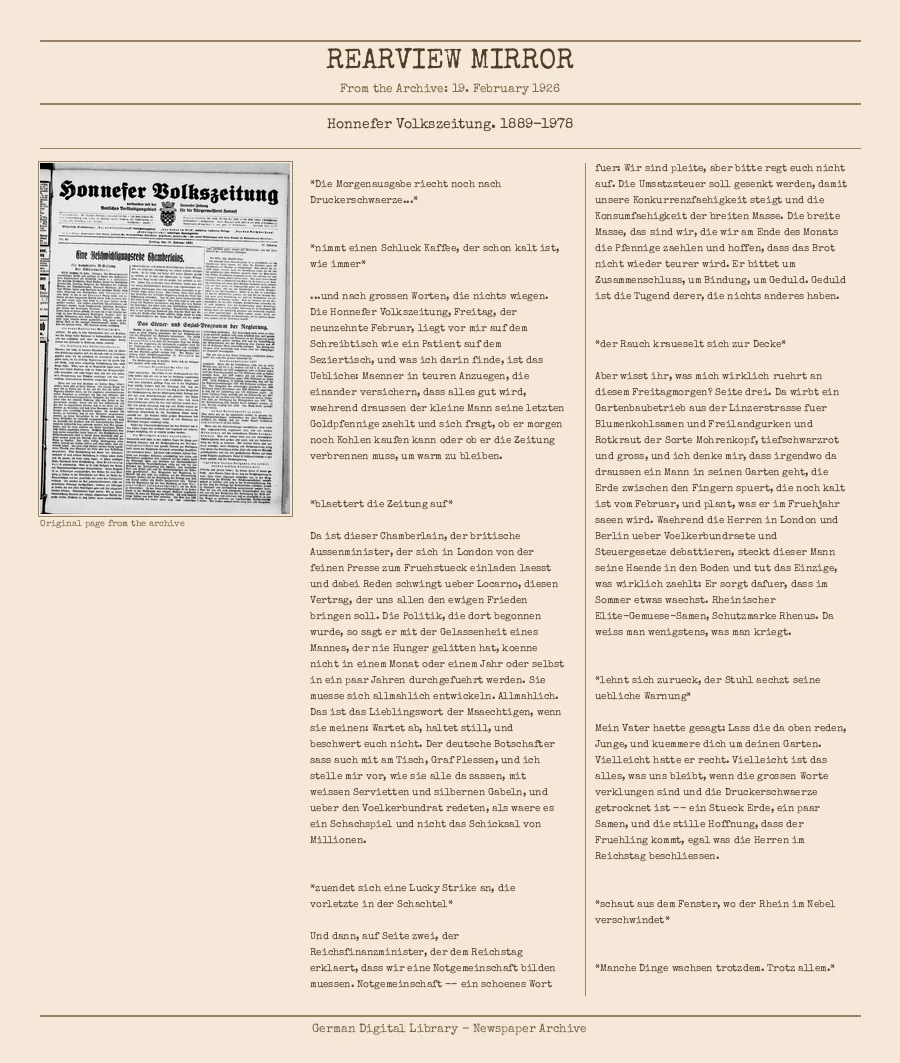
*Die Morgenausgabe riecht noch nach Druckerschwaerze...*
*nimmt einen Schluck Kaffee, der schon kalt ist, wie immer*
...und nach grossen Worten, die nichts wiegen. Die Honnefer Volkszeitung, Freitag, der neunzehnte
Februar, liegt vor mir auf dem Schreibtisch wie ein Patient auf dem Seziertisch, und was ich darin
finde, ist das Uebliche: Maenner in teuren Anzuegen, die einander versichern, dass alles gut wird,
waehrend draussen der kleine Mann seine letzten Goldpfennige zaehlt und sich fragt, ob er morgen
noch Kohlen kaufen kann oder ob er die Zeitung verbrennen muss, um warm zu bleiben.
*blaettert die Zeitung auf*
Da ist dieser Chamberlain, der britische Aussenminister, der sich in London von der feinen Presse
zum Fruehstueck einladen laesst und dabei Reden schwingt ueber Locarno, diesen Vertrag, der uns
allen den ewigen Frieden bringen soll. Die Politik, die dort begonnen wurde, so sagt er mit der
Gelassenheit eines Mannes, der nie Hunger gelitten hat, koenne nicht in einem Monat oder einem Jahr
oder selbst in ein paar Jahren durchgefuehrt werden. Sie muesse sich allmahlich entwickeln.
Allmahlich. Das ist das Lieblingswort der Maaechtigen, wenn sie meinen: Wartet ab, haltet still,
und beschwert euch nicht. Der deutsche Botschafter sass auch mit am Tisch, Graf Plessen, und ich
stelle mir vor, wie sie alle da sassen, mit weissen Servietten und silbernen Gabeln, und ueber den
Voelkerbundrat redeten, als waere es ein Schachspiel und nicht das Schicksal von Millionen.
*zuendet sich eine Lucky Strike an, die vorletzte in der Schachtel*
Und dann, auf Seite zwei, der Reichsfinanzminister, der dem Reichstag erklaert, dass wir eine
Notgemeinschaft bilden muessen. Notgemeinschaft -- ein schoenes Wort fuer: Wir sind pleite, aber
bitte regt euch nicht auf. Die Umsatzsteuer soll gesenkt werden, damit unsere Konkurrenzfaehigkeit
steigt und die Konsumfaehigkeit der breiten Masse. Die breite Masse, das sind wir, die wir am Ende
des Monats die Pfennige zaehlen und hoffen, dass das Brot nicht wieder teurer wird. Er bittet um
Zusammenschluss, um Bindung, um Geduld. Geduld ist die Tugend derer, die nichts anderes haben.
*der Rauch kraueselt sich zur Decke*
Aber wisst ihr, was mich wirklich ruehrt an diesem Freitagmorgen? Seite drei. Da wirbt ein
Gartenbaubetrieb aus der Linzerstrasse fuer Blumenkohlsamen und Freilandgurken und Rotkraut der
Sorte Mohrenkopf, tiefschwarzrot und gross, und ich denke mir, dass irgendwo da draussen ein Mann
in seinen Garten geht, die Erde zwischen den Fingern spuert, die noch kalt ist vom Februar, und
plant, was er im Fruehjahr saeen wird. Waehrend die Herren in London und Berlin ueber
Voelkerbundraete und Steuergesetze debattieren, steckt dieser Mann seine Haende in den Boden und
tut das Einzige, was wirklich zaehlt: Er sorgt dafuer, dass im Sommer etwas waechst. Rheinischer
Elite-Gemuese-Samen, Schutzmarke Rhenus. Da weiss man wenigstens, was man kriegt.
*lehnt sich zurueck, der Stuhl aechzt seine uebliche Warnung*
Mein Vater haette gesagt: Lass die da oben reden, Junge, und kuemmere dich um deinen Garten.
Vielleicht hatte er recht. Vielleicht ist das alles, was uns bleibt, wenn die grossen Worte
verklungen sind und die Druckerschwaerze getrocknet ist -- ein Stueck Erde, ein paar Samen, und die
stille Hoffnung, dass der Fruehling kommt, egal was die Herren im Reichstag beschliessen.
*schaut aus dem Fenster, wo der Rhein im Nebel verschwindet*
*Manche Dinge wachsen trotzdem. Trotz allem.*
*The morning edition still smells of printer's ink...*
*takes a sip of coffee, which is already cold, as always*
...and of big words that weigh nothing. The Honnefer Volkszeitung, Friday, the nineteenth of
February, lies before me on the desk like a patient on the dissecting table, and what I find in it
is the usual: men in expensive suits assuring each other that everything will be alright,
while outside, the little man counts his last gold pennies and wonders if he can still buy coal
tomorrow or if he will have to burn the newspaper to stay warm.
*flips through the newspaper*
There is this Chamberlain, the British Foreign Secretary, who is invited to breakfast by the fine press
in London and gives speeches about Locarno, this treaty that is supposed to bring eternal peace to us
all. The policy that was started there, he says with the calmness of a man who has never gone hungry,
cannot be carried out in a month or a year or even in a few years. It must develop gradually.
Gradually. That is the favorite word of the powerful when they mean: Wait, be still,
and don't complain. The German ambassador was also at the table, Count Plessen, and I
imagine them all sitting there, with white napkins and silver forks, and talking about the League of
Nations Council as if it were a game of chess and not the fate of millions.
*lights a Lucky Strike, the second to last in the pack*
And then, on page two, the Reich Minister of Finance, who explains to the Reichstag that we must form a
community of hardship. Community of hardship -- a nice word for: We're broke, but
please don't get upset. The sales tax is to be lowered so that our competitiveness
increases and the consumption capacity of the broad masses. The broad masses, that's us, who at the end
of the month count the pennies and hope that the bread doesn't get more expensive again. He asks for
unity, for commitment, for patience. Patience is the virtue of those who have nothing else.
*the smoke curls towards the ceiling*
But do you know what really moves me on this Friday morning? Page three. There, a
horticultural company from Linzerstrasse is advertising cauliflower seeds and open-field cucumbers and
red cabbage of the Mohrenkopf variety, deep black-red and large, and I think to myself that somewhere
out there a man goes into his garden, feels the earth between his fingers, which is still cold from
February, and plans what he will sow in the spring. While the gentlemen in London and Berlin
debate League of Nations Councils and tax laws, this man sticks his hands in the soil and
does the only thing that really counts: He makes sure that something grows in the summer. Rhenish
elite vegetable seeds, trademark Rhenus. At least you know what you're getting.
*leans back, the chair creaks its usual warning*
My father would have said: Let those up there talk, boy, and take care of your garden.
Maybe he was right. Maybe that's all that's left to us when the big words
have faded away and the printer's ink has dried -- a piece of earth, a few seeds, and the
silent hope that spring will come, no matter what the gentlemen in the Reichstag decide.
*looks out the window, where the Rhine disappears in the fog*
*Some things still grow. Despite everything.*
---
Kim Benet, 19. Februar 2026