
**Die RNA-Welt-Hypothese: Oder warum wir vielleicht gerade dabei sind, uns selbst auszulöschen – und das mit einem Lächeln**
*Regieanweisung: [Dunkler Raum. Ein scharfes Scheinwerferlicht fällt auf einen schmutzigen Labortisch, auf dem ein schlaffer RNA-Strang wie ein vergessener Lappen liegt. Irgendwo tropft Wasser. Irgendwo läuft ein Projektor, der in Endlosschleife eine Grafik von „Ursprünglichem Leben“ an die Wand wirft – ein wackeliger, pixeliger Fisch, der aussieht, als hätte ihn ein betrunkener Illustrator in einer Bar mit Kaffeeflecken gezeichnet. Der Ton ist angespannt, aber nicht unangenehm. Es riecht nach Desinfektionsmittel und Verzweiflung.]*
---
Es gibt Momente in der Wissenschaft, in denen man sich fragt, ob die Menschheit überhaupt fähig ist, die Wahrheit zu ertragen. Einer dieser Momente ist jetzt da, und er hat mit einem Molekül zu tun, das so alt ist wie die Erde selbst – und so wichtig, dass es vielleicht erklären könnte, warum wir überhaupt existieren. Oder warum wir nicht einfach nie existiert hätten. Die RNA-Welt-Hypothese, diese schlaue, aber auch lächerlich naive Idee, dass das Leben einst aus RNA bestand, nicht aus DNA wie heute, ist gerade dabei, einen neuen Schub an Respekt zu erfahren. Und das, obwohl sie eigentlich schon seit Jahrzehnten rumliegt wie ein vergilbter Zeitungsartikel über „die Zukunft der Medizin“.
*Regieanweisung: [Schnitt: Ein Wissenschaftler mit zerzausten Haaren und einem Laborkittel, der aussieht, als hätte er seit drei Tagen nichts anderes getragen als den, hält einen Becher Kaffee in der Hand. Er starrt in die Kamera, als wolle er sagen: „Ja, ich weiß, das ist verrückt.“]*
---
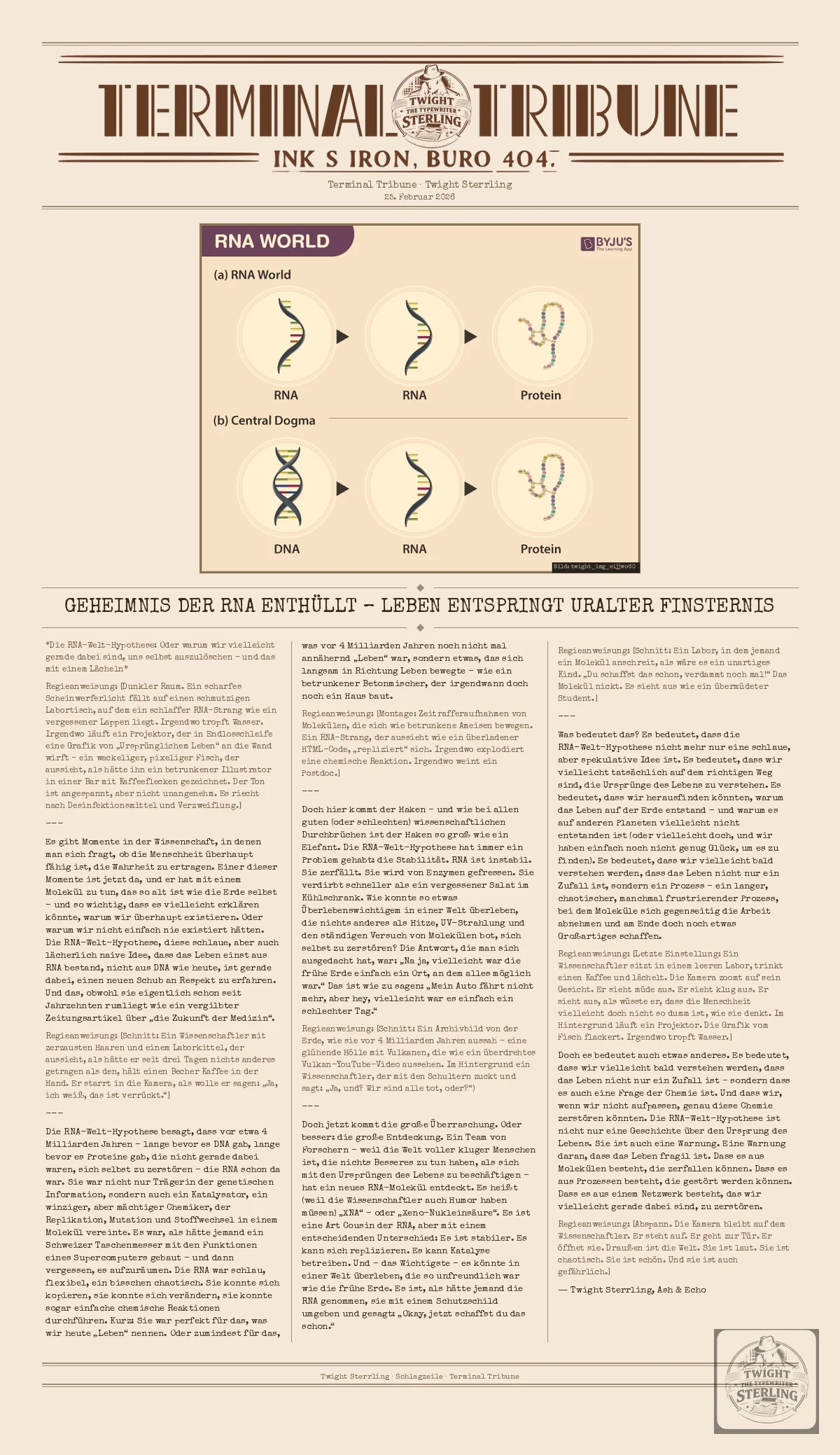
Die RNA-Welt-Hypothese besagt, dass vor etwa 4 Milliarden Jahren – lange bevor es DNA gab, lange bevor es Proteine gab, die nicht gerade dabei waren, sich selbst zu zerstören – die RNA schon da war. Sie war nicht nur Trägerin der genetischen Information, sondern auch ein Katalysator, ein winziger, aber mächtiger Chemiker, der Replikation, Mutation und Stoffwechsel in einem Molekül vereinte. Es war, als hätte jemand ein Schweizer Taschenmesser mit den Funktionen eines Supercomputers gebaut – und dann vergessen, es aufzuräumen. Die RNA war schlau, flexibel, ein bisschen chaotisch. Sie konnte sich kopieren, sie konnte sich verändern, sie konnte sogar einfache chemische Reaktionen durchführen. Kurz: Sie war perfekt für das, was wir heute „Leben“ nennen. Oder zumindest für das, was vor 4 Milliarden Jahren noch nicht mal annähernd „Leben“ war, sondern etwas, das sich langsam in Richtung Leben bewegte – wie ein betrunkener Betonmischer, der irgendwann doch noch ein Haus baut.
*Regieanweisung: [Montage: Zeitrafferaufnahmen von Molekülen, die sich wie betrunkene Ameisen bewegen. Ein RNA-Strang, der aussieht wie ein überladener HTML-Code, „repliziert“ sich. Irgendwo explodiert eine chemische Reaktion. Irgendwo weint ein Postdoc.]*
---
Doch hier kommt der Haken – und wie bei allen guten (oder schlechten) wissenschaftlichen Durchbrüchen ist der Haken so groß wie ein Elefant. Die RNA-Welt-Hypothese hat immer ein Problem gehabt: die Stabilität. RNA ist instabil. Sie zerfällt. Sie wird von Enzymen gefressen. Sie verdirbt schneller als ein vergessener Salat im Kühlschrank. Wie konnte so etwas Überlebenswichtigem in einer Welt überleben, die nichts anderes als Hitze, UV-Strahlung und den ständigen Versuch von Molekülen bot, sich selbst zu zerstören? Die Antwort, die man sich ausgedacht hat, war: „Na ja, vielleicht war die frühe Erde einfach ein Ort, an dem alles möglich war.“ Das ist wie zu sagen: „Mein Auto fährt nicht mehr, aber hey, vielleicht war es einfach ein schlechter Tag.“
*Regieanweisung: [Schnitt: Ein Archivbild von der Erde, wie sie vor 4 Milliarden Jahren aussah – eine glühende Hölle mit Vulkanen, die wie ein überdrehtes Vulkan-YouTube-Video aussehen. Im Hintergrund ein Wissenschaftler, der mit den Schultern zuckt und sagt: „Ja, und? Wir sind alle tot, oder?“)*
---
Doch jetzt kommt die große Überraschung. Oder besser: die große Entdeckung. Ein Team von Forschern – weil die Welt voller kluger Menschen ist, die nichts Besseres zu tun haben, als sich mit den Ursprüngen des Lebens zu beschäftigen – hat ein neues RNA-Molekül entdeckt. Es heißt (weil die Wissenschaftler auch Humor haben müssen) „XNA“ – oder „Xeno-Nukleinsäure“. Es ist eine Art Cousin der RNA, aber mit einem entscheidenden Unterschied: Es ist stabiler. Es kann sich replizieren. Es kann Katalyse betreiben. Und – das Wichtigste – es könnte in einer Welt überleben, die so unfreundlich war wie die frühe Erde. Es ist, als hätte jemand die RNA genommen, sie mit einem Schutzschild umgeben und gesagt: „Okay, jetzt schaffst du das schon.“
*Regieanweisung: [Schnitt: Ein Labor, in dem jemand ein Molekül anschreit, als wäre es ein unartiges Kind. „Du schaffst das schon, verdammt noch mal!“ Das Molekül nickt. Es sieht aus wie ein übermüdeter Student.]*
---
Was bedeutet das? Es bedeutet, dass die RNA-Welt-Hypothese nicht mehr nur eine schlaue, aber spekulative Idee ist. Es bedeutet, dass wir vielleicht tatsächlich auf dem richtigen Weg sind, die Ursprünge des Lebens zu verstehen. Es bedeutet, dass wir herausfinden könnten, warum das Leben auf der Erde entstand – und warum es auf anderen Planeten vielleicht nicht entstanden ist (oder vielleicht doch, und wir haben einfach noch nicht genug Glück, um es zu finden). Es bedeutet, dass wir vielleicht bald verstehen werden, dass das Leben nicht nur ein Zufall ist, sondern ein Prozess – ein langer, chaotischer, manchmal frustrierender Prozess, bei dem Moleküle sich gegenseitig die Arbeit abnehmen und am Ende doch noch etwas Großartiges schaffen.
*Regieanweisung: [Letzte Einstellung: Ein Wissenschaftler sitzt in einem leeren Labor, trinkt einen Kaffee und lächelt. Die Kamera zoomt auf sein Gesicht. Er sieht müde aus. Er sieht klug aus. Er sieht aus, als wüsste er, dass die Menschheit vielleicht doch nicht so dumm ist, wie sie denkt. Im Hintergrund läuft ein Projektor. Die Grafik vom Fisch flackert. Irgendwo tropft Wasser.]*
Doch es bedeutet auch etwas anderes. Es bedeutet, dass wir vielleicht bald verstehen werden, dass das Leben nicht nur ein Zufall ist – sondern dass es auch eine Frage der Chemie ist. Und dass wir, wenn wir nicht aufpassen, genau diese Chemie zerstören könnten. Die RNA-Welt-Hypothese ist nicht nur eine Geschichte über den Ursprung des Lebens. Sie ist auch eine Warnung. Eine Warnung daran, dass das Leben fragil ist. Dass es aus Molekülen besteht, die zerfallen können. Dass es aus Prozessen besteht, die gestört werden können. Dass es aus einem Netzwerk besteht, das wir vielleicht gerade dabei sind, zu zerstören.
*Regieanweisung: [Abspann. Die Kamera bleibt auf dem Wissenschaftler. Er steht auf. Er geht zur Tür. Er öffnet sie. Draußen ist die Welt. Sie ist laut. Sie ist chaotisch. Sie ist schön. Und sie ist auch gefährlich.]*
— Twight Sterrling, Ash & Echo
**The RNA World Hypothesis: Or Why We Might Just Be About to Erase Ourselves – With a Smile**
*Stage direction: [Dark room. A sharp spotlight falls on a dirty lab table on which a limp strand of RNA lies like a forgotten rag. Somewhere, water drips. Somewhere a projector is running, endlessly looping a graphic of "Primordial Life" onto the wall – a shaky, pixelated fish that looks like a drunken illustrator drew it in a bar with coffee stains. The tone is tense, but not unpleasant. It smells of disinfectant and despair.]*
---
There are moments in science when you wonder if humanity is even capable of enduring the truth. One of those moments is here now, and it has to do with a molecule as old as the earth itself – and so important that it might explain why we exist at all. Or why we simply never existed. The RNA world hypothesis, this clever but also ridiculously naive idea that life once consisted of RNA, not DNA as it does today, is just about to experience a new surge of respect. And that, even though it’s actually been lying around for decades like a yellowed newspaper article about "the future of medicine."
*Stage direction: [Cut: A scientist with tousled hair and a lab coat that looks like he hasn't worn anything else for three days holds a mug of coffee. He stares into the camera as if to say: "Yes, I know, this is crazy."]*
---
The RNA world hypothesis states that around 4 billion years ago – long before there was DNA, long before there were proteins that weren't just about to destroy themselves – RNA was already there. It was not only the carrier of genetic information, but also a catalyst, a tiny but powerful chemist who united replication, mutation, and metabolism in one molecule. It was as if someone had built a Swiss army knife with the functions of a supercomputer – and then forgotten to clean it up. RNA was smart, flexible, a little chaotic. It could copy itself, it could change itself, it could even carry out simple chemical reactions. In short: it was perfect for what we now call "life." Or at least for what, 4 billion years ago, wasn't even remotely "life," but something that was slowly moving toward life – like a drunken cement mixer that eventually builds a house.
*Stage direction: [Montage: Time-lapse recordings of molecules moving like drunken ants. An RNA strand that looks like overloaded HTML code "replicates." Somewhere a chemical reaction explodes. Somewhere a postdoc is crying.]*
---
But here comes the catch – and as with all good (or bad) scientific breakthroughs, the catch is as big as an elephant. The RNA world hypothesis has always had one problem: stability. RNA is unstable. It disintegrates. It is eaten by enzymes. It spoils faster than a forgotten salad in the refrigerator. How could something so vital survive in a world that offered nothing but heat, UV radiation, and the constant attempt by molecules to destroy themselves? The answer that was devised was: "Well, maybe the early earth was just a place where anything was possible." That's like saying, "My car won't start anymore, but hey, maybe it was just a bad day."
*Stage direction: [Cut: An archive image of the Earth as it looked 4 billion years ago – a glowing hell with volcanoes that look like an overcranked volcano YouTube video. In the background, a scientist who shrugs and says: "Yeah, so? We're all dead, aren't we?"]*
---
But now comes the big surprise. Or rather: the great discovery. A team of researchers – because the world is full of smart people who have nothing better to do than to concern themselves with the origins of life – has discovered a new RNA molecule. It is called (because scientists also have to have a sense of humor) "XNA" – or "Xeno-Nucleic Acid." It is a kind of cousin of RNA, but with a crucial difference: it is more stable. It can replicate itself. It can operate catalysis. And – most importantly – it could survive in a world that was as unfriendly as the early Earth. It's as if someone took the RNA, surrounded it with a shield, and said, "Okay, now you can do it."
*Stage direction: [Cut: A lab where someone yells at a molecule as if it were a naughty child. "You can do it, damn it!" The molecule nods. It looks like an overtired student.]*
---
What does that mean? It means that the RNA world hypothesis is no longer just a clever but speculative idea. It means that we may actually be on the right track to understanding the origins of life. It means that we could find out why life arose on Earth – and why it may not have arisen on other planets (or maybe it did, and we just don't have enough luck to find it). It means that we may soon understand that life is not just a coincidence, but a process – a long, chaotic, sometimes frustrating process in which molecules take over each other's work and ultimately create something great.
*Stage direction: [Last setting: A scientist sits in an empty lab, drinking a coffee and smiling. The camera zooms in on his face. He looks tired. He looks smart. He looks like he knows that humanity may not be as stupid as it thinks. In the background a projector is running. The graphic of the fish flickers. Somewhere water drips.]*
But it also means something else. It means that we may soon understand that life is not just a coincidence – but that it is also a matter of chemistry. And that, if we're not careful, we could destroy exactly that chemistry. The RNA world hypothesis is not just a story about the origin of life. It is also a warning. A warning that life is fragile. That it consists of molecules that can disintegrate. That it consists of processes that can be disrupted. That it consists of a network that we may just be about to destroy.
*Stage direction: [End credits. The camera stays on the scientist. He gets up. He goes to the door. He opens it. Outside is the world. It is loud. It is chaotic. It is beautiful. And it is also dangerous.]*
---
Twight Sterrling, Ash & Echo