
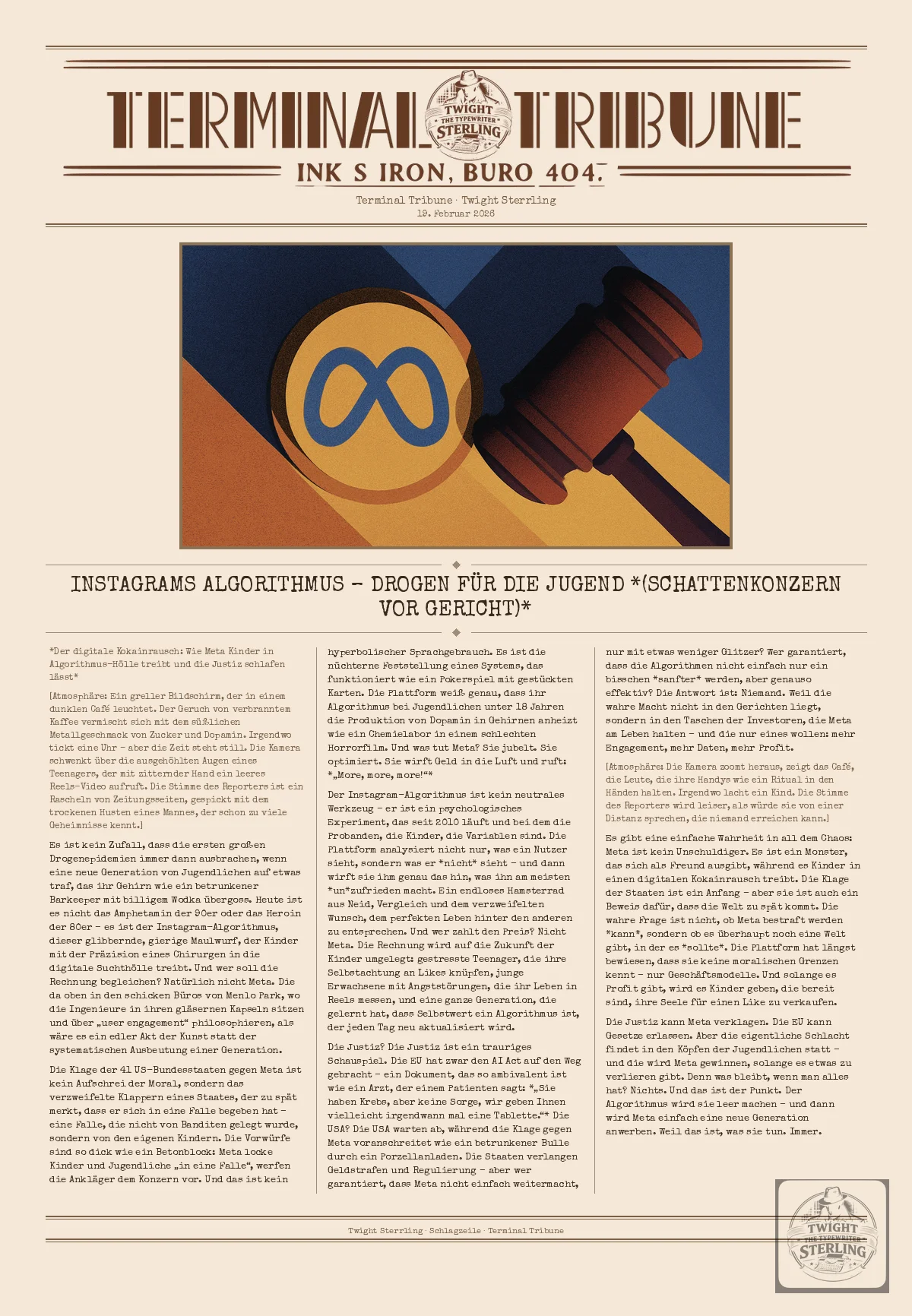
**Der digitale Kokainrausch: Wie Meta Kinder in Algorithmus-Hölle treibt und die Justiz schlafen lässt**
*[Atmosphäre: Ein greller Bildschirm, der in einem dunklen Café leuchtet. Der Geruch von verbranntem Kaffee vermischt sich mit dem süßlichen Metallgeschmack von Zucker und Dopamin. Irgendwo tickt eine Uhr – aber die Zeit steht still. Die Kamera schwenkt über die ausgehöhlten Augen eines Teenagers, der mit zitternder Hand ein leeres Reels-Video aufruft. Die Stimme des Reporters ist ein Rascheln von Zeitungsseiten, gespickt mit dem trockenen Husten eines Mannes, der schon zu viele Geheimnisse kennt.]*
Es ist kein Zufall, dass die ersten großen Drogenepidemien immer dann ausbrachen, wenn eine neue Generation von Jugendlichen auf etwas traf, das ihr Gehirn wie ein betrunkener Barkeeper mit billigem Wodka übergoss. Heute ist es nicht das Amphetamin der 90er oder das Heroin der 80er – es ist der Instagram-Algorithmus, dieser glibbernde, gierige Maulwurf, der Kinder mit der Präzision eines Chirurgen in die digitale Suchthölle treibt. Und wer soll die Rechnung begleichen? Natürlich nicht Meta. Die da oben in den schicken Büros von Menlo Park, wo die Ingenieure in ihren gläsernen Kapseln sitzen und über „user engagement“ philosophieren, als wäre es ein edler Akt der Kunst statt der systematischen Ausbeutung einer Generation.
Die Klage der 41 US-Bundesstaaten gegen Meta ist kein Aufschrei der Moral, sondern das verzweifelte Klappern eines Staates, der zu spät merkt, dass er sich in eine Falle begeben hat – eine Falle, die nicht von Banditen gelegt wurde, sondern von den eigenen Kindern. Die Vorwürfe sind so dick wie ein Betonblock: Meta locke Kinder und Jugendliche „in eine Falle“, werfen die Ankläger dem Konzern vor. Und das ist kein hyperbolischer Sprachgebrauch. Es ist die nüchterne Feststellung eines Systems, das funktioniert wie ein Pokerspiel mit gestückten Karten. Die Plattform weiß genau, dass ihr Algorithmus bei Jugendlichen unter 18 Jahren die Produktion von Dopamin in Gehirnen anheizt wie ein Chemielabor in einem schlechten Horrorfilm. Und was tut Meta? Sie jubelt. Sie optimiert. Sie wirft Geld in die Luft und ruft: *„More, more, more!“*
Der Instagram-Algorithmus ist kein neutrales Werkzeug – er ist ein psychologisches Experiment, das seit 2010 läuft und bei dem die Probanden, die Kinder, die Variablen sind. Die Plattform analysiert nicht nur, was ein Nutzer sieht, sondern was er *nicht* sieht – und dann wirft sie ihm genau das hin, was ihn am meisten *un*zufrieden macht. Ein endloses Hamsterrad aus Neid, Vergleich und dem verzweifelten Wunsch, dem perfekten Leben hinter den anderen zu entsprechen. Und wer zahlt den Preis? Nicht Meta. Die Rechnung wird auf die Zukunft der Kinder umgelegt: gestresste Teenager, die ihre Selbstachtung an Likes knüpfen, junge Erwachsene mit Angststörungen, die ihr Leben in Reels messen, und eine ganze Generation, die gelernt hat, dass Selbstwert ein Algorithmus ist, der jeden Tag neu aktualisiert wird.
Die Justiz? Die Justiz ist ein trauriges Schauspiel. Die EU hat zwar den AI Act auf den Weg gebracht – ein Dokument, das so ambivalent ist wie ein Arzt, der einem Patienten sagt: *„Sie haben Krebs, aber keine Sorge, wir geben Ihnen vielleicht irgendwann mal eine Tablette.“* Die USA? Die USA warten ab, während die Klage gegen Meta voranschreitet wie ein betrunkener Bulle durch ein Porzellanladen. Die Staaten verlangen Geldstrafen und Regulierung – aber wer garantiert, dass Meta nicht einfach weitermacht, nur mit etwas weniger Glitzer? Wer garantiert, dass die Algorithmen nicht einfach nur ein bisschen *sanfter* werden, aber genauso effektiv? Die Antwort ist: Niemand. Weil die wahre Macht nicht in den Gerichten liegt, sondern in den Taschen der Investoren, die Meta am Leben halten – und die nur eines wollen: mehr Engagement, mehr Daten, mehr Profit.
*[Atmosphäre: Die Kamera zoomt heraus, zeigt das Café, die Leute, die ihre Handys wie ein Ritual in den Händen halten. Irgendwo lacht ein Kind. Die Stimme des Reporters wird leiser, als würde sie von einer Distanz sprechen, die niemand erreichen kann.]*
Es gibt eine einfache Wahrheit in all dem Chaos: Meta ist kein Unschuldiger. Es ist ein Monster, das sich als Freund ausgibt, während es Kinder in einen digitalen Kokainrausch treibt. Die Klage der Staaten ist ein Anfang – aber sie ist auch ein Beweis dafür, dass die Welt zu spät kommt. Die wahre Frage ist nicht, ob Meta bestraft werden *kann*, sondern ob es überhaupt noch eine Welt gibt, in der es *sollte*. Die Plattform hat längst bewiesen, dass sie keine moralischen Grenzen kennt – nur Geschäftsmodelle. Und solange es Profit gibt, wird es Kinder geben, die bereit sind, ihre Seele für einen Like zu verkaufen.
Die Justiz kann Meta verklagen. Die EU kann Gesetze erlassen. Aber die eigentliche Schlacht findet in den Köpfen der Jugendlichen statt – und die wird Meta gewinnen, solange es etwas zu verlieren gibt. Denn was bleibt, wenn man alles hat? Nichts. Und das ist der Punkt. Der Algorithmus wird sie leer machen – und dann wird Meta einfach eine neue Generation anwerben. Weil das ist, was sie tun. Immer.
**The Digital Cocaine Rush: How Meta Drives Children into Algorithm Hell and the Justice System Sleeps**
*[Atmosphere: A glaring screen shining in a dark café. The smell of burnt coffee mixes with the sweet metallic taste of sugar and dopamine. Somewhere a clock is ticking – but time stands still. The camera pans over the hollow eyes of a teenager, who calls up an empty Reels video with a trembling hand. The reporter's voice is a rustling of newspaper pages, laced with the dry cough of a man who knows too many secrets.]*
It is no coincidence that the first major drug epidemics always broke out when a new generation of young people encountered something that flooded their brains like a drunken bartender with cheap vodka. Today, it's not the amphetamine of the 90s or the heroin of the 80s – it's the Instagram algorithm, that slimy, greedy mole that drives children into digital addiction hell with the precision of a surgeon. And who is supposed to foot the bill? Of course, not Meta. Those up there in the fancy offices of Menlo Park, where the engineers sit in their glass capsules and philosophize about “user engagement” as if it were a noble act of art instead of the systematic exploitation of a generation.
The lawsuit filed by 41 US states against Meta is not an outcry of morality, but the desperate rattling of a state that realizes too late that it has walked into a trap – a trap that was not set by bandits, but by its own children. The accusations are as thick as a block of concrete: Meta lures children and adolescents "into a trap," the plaintiffs accuse the corporation. And that is not hyperbolic language. It is the sober observation of a system that works like a poker game with rigged cards. The platform knows exactly that its algorithm fuels the production of dopamine in the brains of young people under 18 like a chemistry lab in a bad horror movie. And what does Meta do? It cheers. It optimizes. It throws money into the air and shouts: *"More, more, more!"*
The Instagram algorithm is not a neutral tool – it is a psychological experiment that has been running since 2010, in which the subjects, the children, are the variables. The platform not only analyzes what a user sees, but what he *doesn't* see – and then it throws him exactly what makes him the most *un*happy. An endless hamster wheel of envy, comparison, and the desperate desire to match the perfect lives behind the others. And who pays the price? Not Meta. The bill is passed on to the future of the children: stressed teenagers who tie their self-esteem to likes, young adults with anxiety disorders who measure their lives in reels, and an entire generation that has learned that self-worth is an algorithm that is updated every day.
The judiciary? The judiciary is a sad spectacle. The EU has launched the AI Act – a document that is as ambivalent as a doctor who tells a patient: *"You have cancer, but don't worry, we may give you a tablet at some point."* The USA? The USA is waiting while the lawsuit against Meta progresses like a drunken bull through a china shop. The states are demanding fines and regulation – but who guarantees that Meta won't just keep going, only with a little less glitter? Who guarantees that the algorithms won't just become a little *gentler*, but just as effective? The answer is: No one. Because the real power lies not in the courts, but in the pockets of the investors who keep Meta alive – and who only want one thing: more engagement, more data, more profit.
*[Atmosphere: The camera zooms out, showing the café, the people holding their cell phones in their hands like a ritual. Somewhere a child is laughing. The reporter's voice fades as if speaking from a distance that no one can reach.]*
There is a simple truth in all the chaos: Meta is not an innocent. It is a monster that pretends to be a friend while driving children into a digital cocaine rush. The states' lawsuit is a start – but it is also proof that the world is coming too late. The real question is not whether Meta *can* be punished, but whether there should even be a world in which it *should*. The platform has long proven that it knows no moral boundaries – only business models. And as long as there is profit, there will be children willing to sell their souls for a like.
The justice system can sue Meta. The EU can pass laws. But the real battle is taking place in the minds of young people – and Meta will win it as long as there is something to lose. Because what remains when you have everything? Nothing. And that's the point. The algorithm will empty them – and then Meta will simply recruit a new generation. Because that's what they do. Always.
Kim Benet, 19. Februar 2026