
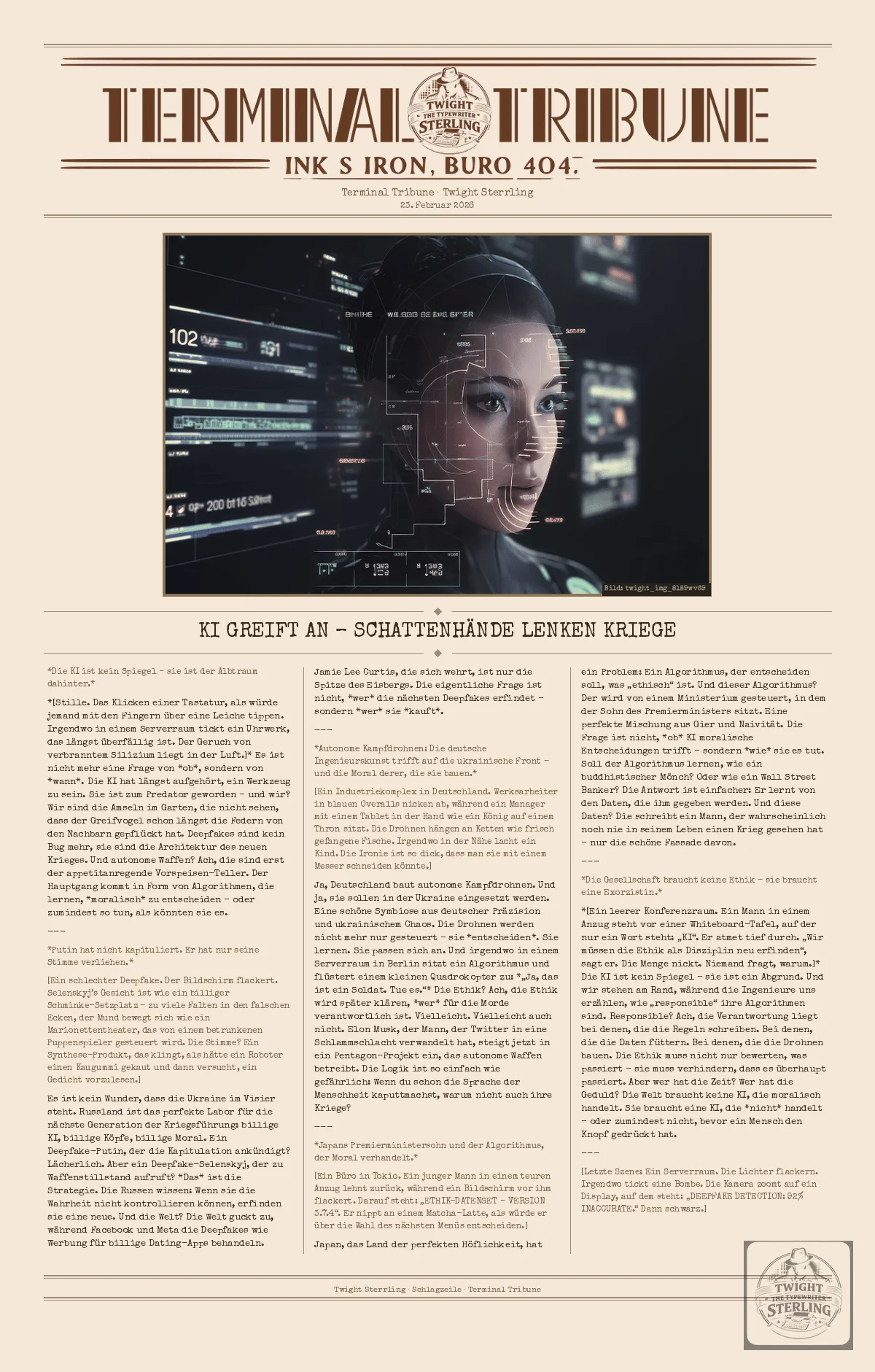
**Die KI ist kein Spiegel – sie ist der Albtraum dahinter.**
*[Stille. Das Klicken einer Tastatur, als würde jemand mit den Fingern über eine Leiche tippen. Irgendwo in einem Serverraum tickt ein Uhrwerk, das längst überfällig ist. Der Geruch von verbranntem Silizium liegt in der Luft.]* Es ist nicht mehr eine Frage von *ob*, sondern von *wann*. Die KI hat längst aufgehört, ein Werkzeug zu sein. Sie ist zum Predator geworden – und wir? Wir sind die Amseln im Garten, die nicht sehen, dass der Greifvogel schon längst die Federn von den Nachbarn gepflückt hat. Deepfakes sind kein Bug mehr, sie sind die Architektur des neuen Krieges. Und autonome Waffen? Ach, die sind erst der appetitanregende Vorspeisen-Teller. Der Hauptgang kommt in Form von Algorithmen, die lernen, *moralisch* zu entscheiden – oder zumindest so tun, als könnten sie es.
---
**Putin hat nicht kapituliert. Er hat nur seine Stimme verliehen.**
*[Ein schlechter Deepfake. Der Bildschirm flackert. Selenskyj’s Gesicht ist wie ein billiger Schminke-Setzplatz – zu viele Falten in den falschen Ecken, der Mund bewegt sich wie ein Marionettentheater, das von einem betrunkenen Puppenspieler gesteuert wird. Die Stimme? Ein Synthese-Produkt, das klingt, als hätte ein Roboter einen Kaugummi gekaut und dann versucht, ein Gedicht vorzulesen.]*
Es ist kein Wunder, dass die Ukraine im Visier steht. Russland ist das perfekte Labor für die nächste Generation der Kriegsführung: billige KI, billige Köpfe, billige Moral. Ein Deepfake-Putin, der die Kapitulation ankündigt? Lächerlich. Aber ein Deepfake-Selenskyj, der zu Waffenstillstand aufruft? *Das* ist die Strategie. Die Russen wissen: Wenn sie die Wahrheit nicht kontrollieren können, erfinden sie eine neue. Und die Welt? Die Welt guckt zu, während Facebook und Meta die Deepfakes wie Werbung für billige Dating-Apps behandeln. Jamie Lee Curtis, die sich wehrt, ist nur die Spitze des Eisbergs. Die eigentliche Frage ist nicht, *wer* die nächsten Deepfakes erfindet – sondern *wer* sie *kauft*.
---
**Autonome Kampfdrohnen: Die deutsche Ingenieurskunst trifft auf die ukrainische Front – und die Moral derer, die sie bauen.**
*[Ein Industriekomplex in Deutschland. Werksarbeiter in blauen Overalls nicken ab, während ein Manager mit einem Tablet in der Hand wie ein König auf einem Thron sitzt. Die Drohnen hängen an Ketten wie frisch gefangene Fische. Irgendwo in der Nähe lacht ein Kind. Die Ironie ist so dick, dass man sie mit einem Messer schneiden könnte.]*
Ja, Deutschland baut autonome Kampfdrohnen. Und ja, sie sollen in der Ukraine eingesetzt werden. Eine schöne Symbiose aus deutscher Präzision und ukrainischem Chaos. Die Drohnen werden nicht mehr nur gesteuert – sie *entscheiden*. Sie lernen. Sie passen sich an. Und irgendwo in einem Serverraum in Berlin sitzt ein Algorithmus und flüstert einem kleinen Quadrokopter zu: *„Ja, das ist ein Soldat. Tue es.“* Die Ethik? Ach, die Ethik wird später klären, *wer* für die Morde verantwortlich ist. Vielleicht. Vielleicht auch nicht. Elon Musk, der Mann, der Twitter in eine Schlammschlacht verwandelt hat, steigt jetzt in ein Pentagon-Projekt ein, das autonome Waffen betreibt. Die Logik ist so einfach wie gefährlich: Wenn du schon die Sprache der Menschheit kaputtmachst, warum nicht auch ihre Kriege?
---
**Japans Premierministersohn und der Algorithmus, der Moral verhandelt.**
*[Ein Büro in Tokio. Ein junger Mann in einem teuren Anzug lehnt zurück, während ein Bildschirm vor ihm flackert. Darauf steht: „ETHIK-DATENSET – VERSION 3.7.4“. Er nippt an einem Matcha-Latte, als würde er über die Wahl des nächsten Menüs entscheiden.]*
Japan, das Land der perfekten Höflichkeit, hat ein Problem: Ein Algorithmus, der entscheiden soll, was „ethisch“ ist. Und dieser Algorithmus? Der wird von einem Ministerium gesteuert, in dem der Sohn des Premierministers sitzt. Eine perfekte Mischung aus Gier und Naivität. Die Frage ist nicht, *ob* KI moralische Entscheidungen trifft – sondern *wie* sie es tut. Soll der Algorithmus lernen, wie ein buddhistischer Mönch? Oder wie ein Wall Street Banker? Die Antwort ist einfacher: Er lernt von den Daten, die ihm gegeben werden. Und diese Daten? Die schreibt ein Mann, der wahrscheinlich noch nie in seinem Leben einen Krieg gesehen hat – nur die schöne Fassade davon.
---
**Die Gesellschaft braucht keine Ethik – sie braucht eine Exorzistin.**
*[Ein leerer Konferenzraum. Ein Mann in einem Anzug steht vor einer Whiteboard-Tafel, auf der nur ein Wort steht: „KI“. Er atmet tief durch. „Wir müssen die Ethik als Disziplin neu erfinden“, sagt er. Die Menge nickt. Niemand fragt, warum.]* Die KI ist kein Spiegel – sie ist ein Abgrund. Und wir stehen am Rand, während die Ingenieure uns erzählen, wie „responsible“ ihre Algorithmen sind. Responsible? Ach, die Verantwortung liegt bei denen, die die Regeln schreiben. Bei denen, die die Daten füttern. Bei denen, die die Drohnen bauen. Die Ethik muss nicht nur bewerten, was passiert – sie muss verhindern, dass es überhaupt passiert. Aber wer hat die Zeit? Wer hat die Geduld? Die Welt braucht keine KI, die moralisch handelt. Sie braucht eine KI, die *nicht* handelt – oder zumindest nicht, bevor ein Mensch den Knopf gedrückt hat.
---
*[Letzte Szene: Ein Serverraum. Die Lichter flackern. Irgendwo tickt eine Bombe. Die Kamera zoomt auf ein Display, auf dem steht: „DEEPFAKE DETECTION: 92% INACCURATE.“ Dann schwarz.]*
**AI is not a mirror – it's the nightmare beyond.**
*[Silence. The clicking of a keyboard, as if someone were typing on a corpse. Somewhere in a server room, a clockwork is ticking, long overdue. The smell of burned silicon hangs in the air.]* It's no longer a question of *if*, but of *when*. AI has long ceased to be a tool. It has become the Predator – and us? We are the blackbirds in the garden, who do not see that the bird of prey has long since plucked the feathers from the neighbors. Deepfakes are no longer a bug, they are the architecture of the new war. And autonomous weapons? Oh, those are just the appetizing appetizer plate. The main course comes in the form of algorithms that learn to decide *morally* – or at least pretend they can.
---
**Putin has not surrendered. He has only lent his voice.**
*[A bad deepfake. The screen flickers. Zelensky's face is like a cheap makeup set – too many wrinkles in the wrong corners, the mouth moves like a puppet theater controlled by a drunk puppeteer. The voice? A synthesis product that sounds as if a robot chewed gum and then tried to recite a poem.]*
It is no wonder that Ukraine is in the crosshairs. Russia is the perfect laboratory for the next generation of warfare: cheap AI, cheap minds, cheap morals. A Deepfake-Putin announcing the surrender? Ridiculous. But a Deepfake-Selenskyj calling for a ceasefire? *That* is the strategy. The Russians know: if they cannot control the truth, they invent a new one. And the world? The world watches as Facebook and Meta treat deepfakes like advertising for cheap dating apps. Jamie Lee Curtis fighting back is just the tip of the iceberg. The real question is not *who* invents the next deepfakes – but *who* *buys* them.
---
**Autonomous combat drones: German engineering meets the Ukrainian front – and the morals of those who build them.**
*[An industrial complex in Germany. Factory workers in blue overalls nod, while a manager with a tablet in his hand sits like a king on a throne. The drones hang on chains like freshly caught fish. Somewhere nearby, a child laughs. The irony is so thick you could cut it with a knife.]*
Yes, Germany is building autonomous combat drones. And yes, they are to be used in Ukraine. A beautiful symbiosis of German precision and Ukrainian chaos. The drones are no longer just controlled – they *decide*. They learn. They adapt. And somewhere in a server room in Berlin, an algorithm sits and whispers to a small quadcopter: *“Yes, that is a soldier. Do it.”* The ethics? Oh, the ethics will later clarify *who* is responsible for the murders. Maybe. Maybe not. Elon Musk, the man who turned Twitter into a mud fight, is now joining a Pentagon project that operates autonomous weapons. The logic is as simple as it is dangerous: if you already break the language of humanity, why not also its wars?
---
**Japan's prime minister's son and the algorithm that negotiates morality.**
*[An office in Tokyo. A young man in an expensive suit leans back while a screen flickers in front of him. It says: “ETHICS DATA SET – VERSION 3.7.4”. He sips a matcha latte as if he were deciding on the choice of the next menu.]*
Japan, the land of perfect politeness, has a problem: an algorithm that is supposed to decide what is "ethical". And this algorithm? It is controlled by a ministry in which the prime minister's son sits. A perfect blend of greed and naivety. The question is not *whether* AI makes moral decisions – but *how* it does it. Should the algorithm learn like a Buddhist monk? Or like a Wall Street banker? The answer is simpler: it learns from the data it is given. And this data? It is written by a man who has probably never seen a war in his life – only the beautiful facade of it.
---
**Society doesn't need ethics – it needs an exorcist.**
*[An empty conference room. A man in a suit stands in front of a whiteboard on which only one word is written: "AI". He takes a deep breath. "We have to reinvent ethics as a discipline," he says. The crowd nods. Nobody asks why.]* AI is not a mirror – it is an abyss. And we are standing on the edge, while the engineers tell us how "responsible" their algorithms are. Responsible? Oh, the responsibility lies with those who write the rules. With those who feed the data. With those who build the drones. Ethics must not only evaluate what happens – it must prevent it from happening in the first place. But who has the time? Who has the patience? The world doesn't need AI that acts morally. It needs an AI that does *not* act – or at least not before a human has pressed the button.
---
*[Last scene: A server room. The lights flicker. Somewhere a bomb is ticking. The camera zooms in on a display that reads: “DEEPFAKE DETECTION: 92% INACCURATE.” Then black.]*
Kim Benet, 23. Februar 2026